Travis Legleiter and Bill Johnson – Purdue Extension Weed Science Specialists
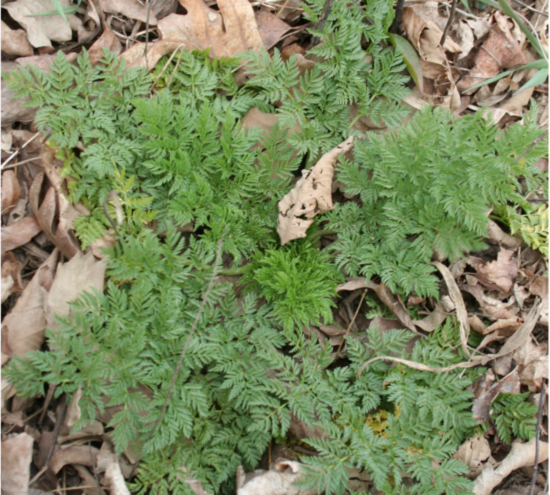
We have received a couple of calls on poison hemlock this spring with concerns of its presence in the Indiana landscape. The appearance of poison hemlock on roadsides and fencerows of Indiana is not new, but the weed may be more prevalent this year as it came out of winter dormancy and has been rapidly growing since the unusually warm days of early March. I myself noticed it being one of the first plants to green up in the roadside ditches this winter as I traveled the state (Image 1). The presence of this weed is not new in Indiana as I can find articles in the Purdue weed science database back to 2003 on the subject of poison hemlock. The largest threat of this weed is the toxicity of it’s alkaloids if ingested by livestock or humans, but it can also be harmful to aesthetic values and has been reported to creep into no-till corn and soybean fields as well.
 |
Image 1. Photo of a green and growing poison hemlock plant in a roadside ditch taken on March 7, 2012 in central Indiana. |
Biology and Identification
Poison Hemlock is a biennual weed that exists as a low growing herb in the first year and bolts to three to eight feet tall in the second year and produces flowers and seed. It is often not noticed or identified as a problem until the bolting and reproductive stages of the second year. The alternate compound leaves are pinnate (finely divided several times) and are usually triangular in outline. Flowers are white and occur in an umbel inflorescence. Poison hemlock is often confused with wild carrot but can be distinguished by its lack of hairs and purple blotches that occur on the stems.
Toxic PropertiesPoison hemlock contains five alkaloids that are toxic to humans and livestock if ingested and can be lethal. All parts of the plants contain the toxic alkaloids with levels being variable throughout the year. Symptoms of toxicity include nervousness, trembling, and loss of coordination followed by depression, coma, and/or death. Initial symptoms will occur within a few hours of ingestion.
Cases of poisoning due to poison hemlock ingestion are rare as the plants emit a mousy odor that makes it undesirable and unpalatable to livestock and humans. Consumption and toxicity in animals usually occurs in poorly managed or overgrazed pastures where animals are forced to graze poison hemlock.
Control Control of poison hemlock with herbicide is most effective when applied to plants in the first year of growth or prior to bolting and flowering in the second year. The closer to reproductive stages, the less effective the herbicide. In roadside ditches, pastures, and waste areas, herbicides containing triclopyr (Remedy Ultra) or triclopyr plus 2,4-D (Crossbow) are most effective in controlling poison hemlock. Other herbicides that provide adequate control when applied at the proper timing are dicamba (Clarity, Banvel), metsulfuron-methyl (Cimarron, Escort XP), metsulfuron-methyl plus dicamba (Cimarron Max) and clopyralid plus 2,4-D (Curtail).
For information on control of poison hemlock in corn and soybean please refer to a previous Purdue Weed Science article:
Poison Hemlock Control in Corn and Soybeans.
For further information on toxic plants in Indiana refer to the Purdue University Weed Science
Guide to Toxic Plants in Forages