This spring so far has been cold and wet with short spurts of warm sunny days in-between. This weather cycle for the most part kept producers out of field and allowed the winter annual weeds to flourish the past couple of weeks. As we look ahead to the next couple of weeks in hope of getting out to the fields to do spring no-till burndown applications, there are a couple of things to keep in mind. <Read More>

Showing posts with label soybeans. Show all posts
Showing posts with label soybeans. Show all posts
Friday, April 19, 2013


Tuesday, January 29, 2013
Upcoming Event - Area Corn and Soybean Day
Purdue Extension Educators from southwest Indiana are
hosting an Area Corn & Soybean Day for grain producers interested in
receiving agronomic, as well as, a local grain market update. The event is being held on Tuesday, February
5th at the Vanderburgh County Fairgrounds Activities building,
beginning with registration at 8:00 AM CST.
Purdue University Agronomy Specialists Bob Nielsen, Shaun
Casteel and Jim Camberato will be the featured speakers on corn, soybeans and
fertilizer topics. In addition,
representatives from area grain elevators will conduct a panel discussion on
grain marketing issues. PARP, CCH, and CEU credit is available.
A complete list of speakers and topics is
available here.
Friday, January 18, 2013
Weekly Outlook - USDA Reports Provide Some Price Direction
On January 11, the USDA released a series of reports that
provide important fundamental information for the crop markets. The information
included the final estimate of the size of the 2012 U.S. corn and soybean crops,
estimates of December 1 crop inventories, a winter wheat seedings estimate, and
updated U.S. and world supply and consumption forecasts for the current
marketing year.
For corn, the 2012 U.S. crop is estimated at 10.78 billion
bushels, 55 million larger than the November forecast. The estimate of planted
acreage of corn for all purposes was increased by 209,000 acres, the estimate of
acreage harvested for grain was reduced by 346,000 acres, and the yield estimate
was increased by 1.1 bushels per acre. The production estimate was larger than
the pre-report average trade guess of just over 10.6 billion bushels, but the
estimate of December 1, 2012 stocks of corn was actually much smaller than the
average guess. <Read More>
Tuesday, December 11, 2012
Weekly Outlook - Will Corn and Soybean Prices Return to Pre-drought Levels?
March 2013 corn futures dropped below $5.50 in early May 2012
and were drifting lower when U.S. drought conditions turned prices higher
starting in mid-June. The price of that contract peaked in early August, just
short of the $8.50 mark. March 2013 soybean futures dropped below $11.50 in
December 2011before South American drought conditions and then U.S. drought
conditions sent that contract above $17.25 by mid-September 2012.
Corn prices have declined by more than $1.00 since the late
summer peak, while soybean prices have declined by more than $3.00. The general
expectation has been that prices of both commodities would return to pre-drought
levels as early as 2013 as consumption adjusted to the lower supplies and as
production rebounded in both South America and the U.S. The futures market
currently reflects expectations that corn prices will moderate substantially
from current levels by the fall of 2013 as larger crops are harvested in
Argentina and then in the U.S. December 2013 futures, for example, are priced
$.95 below December 2012 futures. The soybean market expects prices to moderate
from current levels by the summer of 2013 as a large South American crop is
harvested. August 2013 futures prices are nearly $.60 lower than March 2013
prices. Further price reductions are expected into the fall of 2013 as a larger
U.S. crop is harvested. November 2013 futures are about $0.85 below the price
of August 2013 futures. Still, the prices of both commodities for delivery in
the 2013-14 marketing year are well above the levels prior to the drought of
2012. <Read More>
Friday, November 30, 2012
Focus on Soybean Oil
The sharp increase in soybean prices that began in June 2012
and peaked in early September 2012 was carried more by soybean meal prices than
by soybean oil prices. From the June low to the September peak, January 2013
soybean futures increased by 43 percent, January soybean meal futures increased
by 51 percent, and January soybean oil futures gained 20 percent. Soybean oil
futures are now back to the level of early June, while soybean futures are 13
percent above the early June level and soybean meal futures are 21 percent
higher.
For the 2012-13 marketing year, the USDA expects soybean oil
prices to remain weak relative to soybean meal prices. The price of crude oil at
Decatur, Illinois is expected to average 2.26 times the price (per pound) of 48
percent protein meal at Decatur. The ratio of average prices was 3.08 during
the 2010-11 marketing year and 2.64 last year. In nominal terms, the average
price of soybean oil is projected in a range of $0.51 to $0.55 per pound,
compared to an average of $0.519 last year and $0.532 during the 2010-11
marketing year. On the other hand, the average prices of soybeans and soybean
meal are projected to be substantially above the averages of the previous two
years. <Read More>
Tuesday, November 13, 2012
Upcoming Event - Ohio Valley Precision Ag Conference
Purdue Extension and University of Kentucky Extension will jointly host a Nov. 29 conference to teach farmers more about how precision agriculture systems could improve their bottom lines.
The Ohio Valley Precision Ag Conference will run from 9 a.m. to 2:30 p.m. (CST) at the Vanderburgh County 4-H Fairgrounds, 201 E. Boonville-New Harmony Road, Evansville. It will cover data management, implement systems technologies, and systems calibration and setup. It also will feature local precision agriculture companies and projects.
"The variety of technologies that farmers and industry representatives have to evaluate for on-farm use is staggering," said Kenneth Eck, Purdue Extension educator in Dubois County. "This conference will give folks a better understanding of what systems are available, how emerging technologies might mesh with producers' current systems, and how both farmers and agribusinesses can manage farm data for improved economic and environmental results."
The conference will start with a presentation titled "Data Utilization and Management with Precision Tools" by Betsy Bower and Troy Walker of Ceres Solutions.
Morning breakout sessions are:
- "RTK Accuracy" by Tim Stombaugh, associate professor of biosystems and agricultural engineering at the University of Kentucky.
- "Calibration Basics - John Deere" by Ben Carlisle, Wright-Stemle John Deere.
- "Variable Rate Seeding - Can You Do It and Do You Need To?" by Bob Nielsen, Purdue Extension agronomist.
Afternoon breakout sessions are:
- A repeat of Stombaugh's "RTK Accuracy."
- "Calibration Basics – Trimble/Case IH" by Kevin Roy and Kristina Nadin, Hopf Equipment Case IH.
- "Economics of Investing or Upgrading: Old vs. New" by Greg Halich, associate Extension professor of agricultural economics at the University of Kentucky.
The conference also will feature a farmer panel discussion titled "What Do We Do With the Data and How is It Managed?" The keynote presentation will be "Precision Planting" by Gregg Sauder of Precision Planting Inc.
"This is the first time we've pulled together a program with so much of our expertise in one place," Eck said.
Conference registration is free, but reservations are required by Nov. 19. Participants can register online at http://tinyurl.com/pukyregister or by contacting any of the sponsoring Purdue Extension or University of Kentucky Extension county offices. Those counties in Indiana are Daviess, Dubois, Knox, Perry, Pike, Posey, Spencer, Vanderburgh and Warrick. In Kentucky they are Daviess, Henderson, McLean, Ohio, Union and Webster.
A flyer for the program is available here.
Weekly Outlook - Corn and Soybean Prices Following Short-crop Pattern
The USDA’s November forecasts of the size of the 2012 U.S.
corn and soybean crops were larger than expected, particularly for soybeans. As
a result, the general downtrend in soybean prices since mid-September has
accelerated, with January futures now at the lowest level since June 29. Corn
prices have moved into the lower half of the trading range that has been in
place since mid-September and December futures are at the lowest level since
September 28. So far, prices seem to be following the classic pattern
associated with small crops –peaking early in the marketing year and then
declining as the year progresses.
The futures market reflects expectations that prices will
continue to decline, especially into the 2013-14 marketing year. The expected
rebound in South American soybean production, Argentine corn production, and
U.S. corn and soybean production in 2013 all contribute to the expectation of
lower prices. If those crops are as large as generally expected, prices will be
even lower than currently reflected in the futures market. The USDA is
forecasting record South American production of both crops. If planted acreage
of corn in the U.S. in 2013 is at the same level as in 2012 and the U.S. average
yield is near a trend value of 162.5 bushels, the crop would total 14.6 billion
bushels, about 1.5 billion larger than the record crop and record consumption of
the 2009-10 marketing year. <Read More>
Friday, October 19, 2012
Weekly Outlook - Beyond the October Production Forcasts for Corn and Soybeans
At 10.706 billion bushels, the USDA’s October forecast of the
U.S. corn crop was about 100 million bushels larger than the average trade guess
and about equal to the September forecast. The October soybean forecast, at
2.86 billion bushels was about 90 million bushels larger than the average trade
guess and 126 million larger than the September forecast. Prices of both
commodities increased immediately after the forecasts were released.
The positive response to what appeared to be neutral to
negative production forecasts suggest that the market had priced in the risk of
even larger production forecasts. In addition the USDA forecast year ending
stocks of both commodities to be near pipeline levels, and smaller than expected
in the case of corn. In the case of soybeans, the projection of marketing year
consumption was increased by 150 million bushels. Some interpreted the increase
as a reflection of stronger demand than had been previously forecast. <Read More>
Friday, October 12, 2012
Weekly Outook - Corn and Soybean Prices Searching for Support
December 2012 corn futures declined by $1.44 (17 percent)
from the high on August 10 to the recent low on September 28. That contract has
managed a recovery of about $0.40 so far this month. November 2012 soybean
futures declined by $2.85 (16 percent) from the high on September 4 to the low
on October 3 and have rebounded about $0.45 since then.
Prices over the past two months for corn and the past month
for soybeans appear to be in the classic “short crop, long tail” pattern where
prices peak early in a year of sharply lower production and then decline in the
post-harvest period as the smaller supplies get rationed and production rebounds
in the following year. A change in the trend of lower prices will require an
additional supply shock or evidence that supplies have not been sufficiently
rationed. <Read More>
Wednesday, August 22, 2012
Weekly Outlook - Rationing the 2012 US Soybean Crop
The small South American soybean crop of 2012 will result in
much smaller inventories of that crop by the end of the year. However, that
draw down in stocks in combination with the much larger harvest expected in 2013
suggests that the pace of consumption of South American soybeans will not have
to slow. In contrast, the small U.S. harvest this year will require a
substantial reduction in consumption over the next year.
The magnitude of the year-over-year reduction in consumption
of U.S. soybeans that will be required is not yet known. The new production
forecast to be released on September 12 and the estimate of September 1stocks of
old crop soybeans to be released on September 28 will provide for a better
estimate of the needed decline. Based on the USDA’s August forecasts, a
reduction of 400 million bushels (12.7 percent) will be required. The pace of
consumption, as revealed in weekly export reports and monthly reports of
domestic crush, will be monitored to verify that the pace of consumption is
slowing. <Read More>
Tuesday, August 14, 2012
Weekly Outook - Corn and Soybean Forecasts, What's Next?
The USDA’s August Crop Production report confirmed
prospects for small U.S. corn and soybean crops and the need for consumption of
both crops to decline sharply in the year ahead. Prices will now begin to
reflect expectations for any changes in the production forecasts and
confirmation that the necessary rationing is occurring. Indications of the pace
of consumption will be provided by weekly reports of exports, ethanol
production, and broiler placements and monthly reports of the domestic soybean
crush, cattle feedlot inventories, and dairy cow numbers. New production
forecasts will be released in September, October, and November and the final
estimate will be released in January. <Read More>
Tuesday, July 31, 2012
Weekly Outlook - Anticipating the Size of the 2012 Corn and Soybean Crops
The National Agricultural Statistics Service (NASS) of the
USDA will release the first yield and production forecasts for the 2012 U.S.
corn and soybean crops on August 10. The first forecasts of the season are
always highly anticipated, but none more than this year as widespread drought
conditions have resulted in a wide range of yield and production
expectations.
It might be useful to briefly review the NASS methodology for
making corn and soybean yield and production forecasts. Data for the forecasts
are collected in two separate surveys conducted roughly in the last week of July
and the first week of August for the August report. The Agricultural Yield
Survey (AYS) queries farm operators in 32 states for corn and 29 states for
soybeans asking operators to identify the number of acres to be harvested and to
forecast the final average yield. The sample of operators is based on a
sophisticated sample design to achieve the desired sample size and each state is
expected to achieve a minimum response rate of 80 percent. In 2011,
approximately 27,000 operators were surveyed for all crops for the August
report. Each operator is surveyed in subsequent months to obtain new forecasts
of acreage and yield. Historical relationships indicate that respondents tend to
be conservative in early forecasts of final yields (underestimate yield
potential), particularly in drought years. This tendency is quantified and
factored into official yield forecasts. <Read More>
Thursday, July 26, 2012
Weekly Outlook - Are Soybean Prices High Enough?
Much of the recent attention in commodity markets, at least
in the popular press, has focused on the U.S. corn crop and the potential impact
of drought conditions on production and prices. The focus has been warranted
since corn is the largest U.S. crop; corn is used in a wide variety of food,
feed, and industrial products; and corn yields are most susceptible to drought
conditions.
As the growing season progresses and adverse weather
conditions persist over large areas, more attention is being focused on the U.S.
soybean crop. The importance of the size of the U.S. crop is magnified by the
small South American harvest earlier this year. The USDA estimates that crop at
4.2 billion bushels, 16 percent smaller than the record crop of 2011. The USDA
expects South America to maintain a large export presence, however, by sharply
reducing inventories over the next year. Even so, the pace of exports of U.S.
soybeans remains stronger than normal for this time of year. The USDA now
projects 2011-12 marketing year exports at 1.34 billion bushels, 65 million more
than projected in March. With only six weeks left in the marketing year, exports
need to total 81 million bushels, 13.2 million per week, to reach the USDA
projection. Export inspections for the four weeks ended July 17 averaged 16.1
million. As of July 12, the USDA reported unshipped export sales for the current
year at 171.5 million bushels. It appears that exports may marginally exceed the
USDA projection. <Read More>
Thursday, June 28, 2012
Extreme Drought and Heat Wave - Not a Good Combination

In the previous drought post, it was noted that if upcoming rainfall chances did not materialize, we could be at a tipping point for much worse drought conditions. Well, as we all know, those weather systems did not materialize and we are seeing increasingly widespread drought effects on crops, lawns, and gardens. This week's US Drought Monitor report has placed the majority of Spencer County in the the "extreme" category and the 7-day forecast from the National Weather Service indicates 100+ degree temperatures each day with no chance of rain.
Purdue Extension and the Extension Disaster Education Network have developed a drought information website that compiles drought management tips and resources for consumers, homeowners, and agricultural producers. This site will continue to be updated with information as long as the drought conditions persist. I encourage you to check out this this regularly for updates.
Also, two articles have recently been released addressing the continued drought effects on corn and soybean production. Links to those publications are listed below:
Hot & Dry: Stress on the Corn Crop Escalates
Signs of Drought Stress in Soybeans
Weekly Outlook - Soybean Fundamentals Remain Strong
Soybean prices began moving higher in July 2010, starting
from about $9.50. July 2012 soybean futures reached a high of about $14.70 in
late August 2011, declined to a low near $11.25 in mid-December 2011, and
reached a high of $15.12 in early May 2012. Prices have been very choppy the
past two months, but the July futures contract is now trading within about $.30
of the early May high. November 2012 futures prices have been lower than July
futures, but have followed a similar pattern and are now trading at a contract
high near $14.30.
U.S. soybean market fundamentals have been strong for an
extended period of time. The strong fundamental factors have included record
large exports in 2009-10 and 2010-11 as Chinese demand expanded, a reduction in
U.S. soybean acreage in 2011, a relatively low U.S. average yield in 2011,
intentions to reduce U.S. acreage again in 2012, and a very small soybean
harvest in South America this year. These strong market fundamentals continue in
the form of a rapid pace of consumption and concerns about the size of the 2012
U.S. crop. <Read More>
Friday, June 15, 2012
Drought....and the Potential for More Drought
 |
| US Drought Monitor report for Indiana. For more information, see the Drought Monitor website. |
So far, Spencer County has fared better than our neighbors to the west and northwest. Though we are in the moderate drought category, infrequent but timely rainfall, combined with cooler temperatures, especially overnight, have kept drought effects in crops, gardens, and home landscapes from becoming widespread.
There is a slight chance of scattered showers this weekend but according to staff at the Indiana State Climate Office, the next chance for more widespread, substantial rainfall is not until late next week. As a result, we are in a bit of a wait-and-see pattern as far as how the drought will progress, with the next 10-14 days being crucial. If one or both of these predicted systems produce rainfall, it could be just the timely rain event we need to hold off further drought progression, at least for a few more weeks. However, if these systems fail to bring moisture, we could then be at the tipping point for something much more severe.
As we watch how the situation progresses over the next two weeks, we will continue to post drought management information on the Gazette, on our Facebook page, and in our bi-monthly newsletter. In the meantime, below are two articles addressing the topic. The first is a recent article covering the effects we are currently seeing in corn and soybean crops. The second, originally written in 2007, covers tips for home gardens and landscapes.
More Crops Affected as Drought Spreads Throughout Indiana
Help Your Garden Cope with Dry Spell
Weekly Outlook - Update on Export Progress
Much of the attention in the crop markets is rightly focused
on the potential size of the northern hemisphere crops. Still, the on-going pace
of consumption is an important measure of demand strength and the likely level
of year ending stocks. Here we focus on the U.S. export sector for wheat, corn,
and soybeans.
For wheat, the 2011-12 marketing year ended on May 31.
Cumulative export inspections for the year totaled 1.036 billion bushels,
slightly above last month's USDA projection of 1.025 billion bushels. Through
April, cumulative Census Bureau export estimates were about 4 million bushels
less than cumulative inspections. Assuming that margin persisted through May,
marketing year exports were about 7 million bushels larger than forecast. For
the marketing year that began on June 1, the USDA has projected exports at 1.150
billion bushels. As of May 31, new sales plus unshipped sales from the past
marketing year totaled 235.6 million bushels, near the level of sales of a year
earlier. To reach the USDA projection, shipments will need to average about 22.1
million bushels per week this year. Export inspections during the first week of
the year were reported at 21.5 million bushels. <Read More>
Tuesday, June 5, 2012
Weekly Outlook - Soybean Price Roller Coaster
November 2012 soybean futures reached a high of $14 in
September 2011, declined to about $11.20 in December 2011, rebounded to almost
$14 in early April and again in early May 2012, and traded to a low of $12.45 in
the current trading session. The wide price swings reflect ever-changing supply
and demand expectations.
Much of the strength in soybean prices during the first three
months of this year reflected deteriorating production prospects in South
America. The USDA currently projects production in five South American countries
at 4.237 billion bushels, 779 million bushels (15.5 percent) smaller than the
2011 harvest and 833 million bushels (16.4 percent) smaller than the December
2011 forecast. Some believe the crop to be even smaller. The USDA will provide
an updated estimate on June 12. Much of the price weakness over the past few
weeks reflects growing concerns about the U.S. and world economic and financial
conditions and the negative implications for commodity demand. <Read More>
Monday, May 21, 2012
Poison Hemlock - A Mini Review
Travis Legleiter and Bill Johnson – Purdue Extension Weed Science Specialists
We have received a couple of calls on poison hemlock this spring with concerns of its presence in the Indiana landscape. The appearance of poison hemlock on roadsides and fencerows of Indiana is not new, but the weed may be more prevalent this year as it came out of winter dormancy and has been rapidly growing since the unusually warm days of early March. I myself noticed it being one of the first plants to green up in the roadside ditches this winter as I traveled the state (Image 1). The presence of this weed is not new in Indiana as I can find articles in the Purdue weed science database back to 2003 on the subject of poison hemlock. The largest threat of this weed is the toxicity of it’s alkaloids if ingested by livestock or humans, but it can also be harmful to aesthetic values and has been reported to creep into no-till corn and soybean fields as well.
Biology and Identification
Poison Hemlock is a biennual weed that exists as a low growing herb in the first year and bolts to three to eight feet tall in the second year and produces flowers and seed. It is often not noticed or identified as a problem until the bolting and reproductive stages of the second year. The alternate compound leaves are pinnate (finely divided several times) and are usually triangular in outline. Flowers are white and occur in an umbel inflorescence. Poison hemlock is often confused with wild carrot but can be distinguished by its lack of hairs and purple blotches that occur on the stems.
Toxic Properties
Poison hemlock contains five alkaloids that are toxic to humans and livestock if ingested and can be lethal. All parts of the plants contain the toxic alkaloids with levels being variable throughout the year. Symptoms of toxicity include nervousness, trembling, and loss of coordination followed by depression, coma, and/or death. Initial symptoms will occur within a few hours of ingestion.
Cases of poisoning due to poison hemlock ingestion are rare as the plants emit a mousy odor that makes it undesirable and unpalatable to livestock and humans. Consumption and toxicity in animals usually occurs in poorly managed or overgrazed pastures where animals are forced to graze poison hemlock.
Control
Control of poison hemlock with herbicide is most effective when applied to plants in the first year of growth or prior to bolting and flowering in the second year. The closer to reproductive stages, the less effective the herbicide. In roadside ditches, pastures, and waste areas, herbicides containing triclopyr (Remedy Ultra) or triclopyr plus 2,4-D (Crossbow) are most effective in controlling poison hemlock. Other herbicides that provide adequate control when applied at the proper timing are dicamba (Clarity, Banvel), metsulfuron-methyl (Cimarron, Escort XP), metsulfuron-methyl plus dicamba (Cimarron Max) and clopyralid plus 2,4-D (Curtail).
For information on control of poison hemlock in corn and soybean please refer to a previous Purdue Weed Science article: Poison Hemlock Control in Corn and Soybeans.
For further information on toxic plants in Indiana refer to the Purdue University Weed Science Guide to Toxic Plants in Forages
We have received a couple of calls on poison hemlock this spring with concerns of its presence in the Indiana landscape. The appearance of poison hemlock on roadsides and fencerows of Indiana is not new, but the weed may be more prevalent this year as it came out of winter dormancy and has been rapidly growing since the unusually warm days of early March. I myself noticed it being one of the first plants to green up in the roadside ditches this winter as I traveled the state (Image 1). The presence of this weed is not new in Indiana as I can find articles in the Purdue weed science database back to 2003 on the subject of poison hemlock. The largest threat of this weed is the toxicity of it’s alkaloids if ingested by livestock or humans, but it can also be harmful to aesthetic values and has been reported to creep into no-till corn and soybean fields as well.
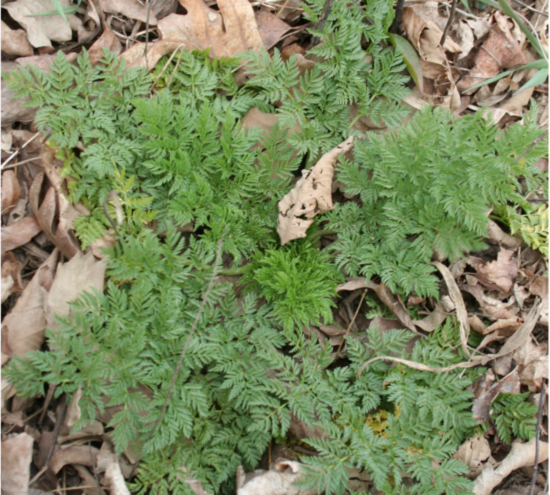 |
Image 1. Photo of a green and growing poison hemlock plant in a roadside ditch taken on March 7, 2012 in central Indiana. |
Poison Hemlock is a biennual weed that exists as a low growing herb in the first year and bolts to three to eight feet tall in the second year and produces flowers and seed. It is often not noticed or identified as a problem until the bolting and reproductive stages of the second year. The alternate compound leaves are pinnate (finely divided several times) and are usually triangular in outline. Flowers are white and occur in an umbel inflorescence. Poison hemlock is often confused with wild carrot but can be distinguished by its lack of hairs and purple blotches that occur on the stems.
Toxic Properties
Poison hemlock contains five alkaloids that are toxic to humans and livestock if ingested and can be lethal. All parts of the plants contain the toxic alkaloids with levels being variable throughout the year. Symptoms of toxicity include nervousness, trembling, and loss of coordination followed by depression, coma, and/or death. Initial symptoms will occur within a few hours of ingestion.
Cases of poisoning due to poison hemlock ingestion are rare as the plants emit a mousy odor that makes it undesirable and unpalatable to livestock and humans. Consumption and toxicity in animals usually occurs in poorly managed or overgrazed pastures where animals are forced to graze poison hemlock.
Control
Control of poison hemlock with herbicide is most effective when applied to plants in the first year of growth or prior to bolting and flowering in the second year. The closer to reproductive stages, the less effective the herbicide. In roadside ditches, pastures, and waste areas, herbicides containing triclopyr (Remedy Ultra) or triclopyr plus 2,4-D (Crossbow) are most effective in controlling poison hemlock. Other herbicides that provide adequate control when applied at the proper timing are dicamba (Clarity, Banvel), metsulfuron-methyl (Cimarron, Escort XP), metsulfuron-methyl plus dicamba (Cimarron Max) and clopyralid plus 2,4-D (Curtail).
For information on control of poison hemlock in corn and soybean please refer to a previous Purdue Weed Science article: Poison Hemlock Control in Corn and Soybeans.
For further information on toxic plants in Indiana refer to the Purdue University Weed Science Guide to Toxic Plants in Forages
Thursday, April 26, 2012
Crop Outlook is Favorable, but Mother Nature Rules
Chris Hurt, Purdue Extension Agricultural Economics Specialist
Mother Nature always gets the last word when it comes to determining crop yields across Indiana. Last year she was unkind as a wet spring caused planting delays and then heat and dryness in mid-summer caused yield losses. Yields for both corn and soybeans were nearly 10 percent below normal.
Farmers are anxious for the new growing season in 2012 and the weather is giving them an early start. A warm and relatively dry winter means the planting season has started early increasing prospects for a return to favorable yields.
While crop production was down in 2011, prices were at record highs. This meant that revenues for Indiana's major crops of corn, soybeans, and wheat reached a record high level of about $8.3 billion.
A return to more normal crop production in 2012 could also bring lower prices, especially for corn. Increased production at lower prices means that total revenues would not change very much from the $8.3 billion from the 2011 crop.
However, what will change this year are higher production costs. Purdue University estimates suggest that costs of producing these crops will increase by 15 to 20 percent in 2012 compared to last year. Higher costs are led by fertilizer, fuel, and cash rents. These elevated costs mean the net returns or profits from Indiana cropland are expected to drop from the record levels achieved in the past two years.
While a decline in returns is never welcomed, the decline is coming from record high levels. This means that crop incomes are expected to decline in 2012, but will still be strong relative to average incomes over the past decade.
While prospects are favorable this spring, Mother Nature and market prices will ultimately determine the financial success of Indiana's 2012 crops.
Mother Nature always gets the last word when it comes to determining crop yields across Indiana. Last year she was unkind as a wet spring caused planting delays and then heat and dryness in mid-summer caused yield losses. Yields for both corn and soybeans were nearly 10 percent below normal.
Farmers are anxious for the new growing season in 2012 and the weather is giving them an early start. A warm and relatively dry winter means the planting season has started early increasing prospects for a return to favorable yields.
While crop production was down in 2011, prices were at record highs. This meant that revenues for Indiana's major crops of corn, soybeans, and wheat reached a record high level of about $8.3 billion.
A return to more normal crop production in 2012 could also bring lower prices, especially for corn. Increased production at lower prices means that total revenues would not change very much from the $8.3 billion from the 2011 crop.
However, what will change this year are higher production costs. Purdue University estimates suggest that costs of producing these crops will increase by 15 to 20 percent in 2012 compared to last year. Higher costs are led by fertilizer, fuel, and cash rents. These elevated costs mean the net returns or profits from Indiana cropland are expected to drop from the record levels achieved in the past two years.
While a decline in returns is never welcomed, the decline is coming from record high levels. This means that crop incomes are expected to decline in 2012, but will still be strong relative to average incomes over the past decade.
While prospects are favorable this spring, Mother Nature and market prices will ultimately determine the financial success of Indiana's 2012 crops.
Subscribe to:
Posts (Atom)