This spring so far has been cold and wet with short spurts of warm sunny days in-between. This weather cycle for the most part kept producers out of field and allowed the winter annual weeds to flourish the past couple of weeks. As we look ahead to the next couple of weeks in hope of getting out to the fields to do spring no-till burndown applications, there are a couple of things to keep in mind. <Read More>

Showing posts with label weeds. Show all posts
Showing posts with label weeds. Show all posts
Friday, April 19, 2013


Tuesday, March 26, 2013
Impact of Cool Temperatures on Wheat Herbicides
Jim Martin, University of Kentucky Extension Weed Scientist
The cool temperatures we experienced this spring caused some wheat growers to delay herbicide applications in anticipation of better weather. Stress conditions such as cool temps tend to limit physiological process in plants; therefore, slowing the response of weeds to the herbicide. The desired level of control may eventually be achieved; however, in some instances the slower activity may allow time for some weeds to recover. The slower activity caused by environmental stress, such as cool temperatures, may also limit wheat’s ability to metabolize herbicides, thus resulting in injury.
The immediate forecast doesn’t look favorable which prompts growers to ask “Do I spray or wait for better weather?”
The logical choice would be to wait for improved conditions if the size and number of weeds are small. However, if the size or number of weeds dictates to spray, consider an herbicide option that has the greatest margin of safety and is effective on the weeds that are present. Cool temperatures may have less of an impact on controlling weeds that are highly susceptible than those that are marginally susceptible.
The following are some tips to consider as we progress through the next few days,
• Harmony and Harmony Extra are examples of ALS- inhibitor herbicides that can injure wheat in cool wet soil conditions. Injury may also occur if wide fluctuations of day and nighttime temperatures occur prior to, or soon after, application It is not clear to what extent, if any, the injury observed for Harmony and Harmony Extra impacts wheat yield. The labels of these products recommend adding 2,4-D as a tank mix partner to limit the risk of injuring wheat from the ALS-inhibitor herbicides. It is important to recognize the safest time to use 2,4-D in wheat is when plants are fully tillered and prior to jointing.
• Some growers may be tempted to include Clarity, Banvel, or other products that contain dicamba as a tankmix partner with other herbicides to enhance control of certain broadleaf weeds. Avoid using dicamba once wheat begins to joint in order to limit the risk of injuring wheat.
• When controlling wild garlic with Harmony, Harmony Extra, or similar generic products, allow time for plants to develop 2 to 4 inches of actively growing tissue. The new growth emerges from the base of the plants and not from the old leaves that have tip burn from cold temperatures.
 |
| Snow covered wheat in late March |
The cool temperatures we experienced this spring caused some wheat growers to delay herbicide applications in anticipation of better weather. Stress conditions such as cool temps tend to limit physiological process in plants; therefore, slowing the response of weeds to the herbicide. The desired level of control may eventually be achieved; however, in some instances the slower activity may allow time for some weeds to recover. The slower activity caused by environmental stress, such as cool temperatures, may also limit wheat’s ability to metabolize herbicides, thus resulting in injury.
The immediate forecast doesn’t look favorable which prompts growers to ask “Do I spray or wait for better weather?”
The logical choice would be to wait for improved conditions if the size and number of weeds are small. However, if the size or number of weeds dictates to spray, consider an herbicide option that has the greatest margin of safety and is effective on the weeds that are present. Cool temperatures may have less of an impact on controlling weeds that are highly susceptible than those that are marginally susceptible.
The following are some tips to consider as we progress through the next few days,
• Harmony and Harmony Extra are examples of ALS- inhibitor herbicides that can injure wheat in cool wet soil conditions. Injury may also occur if wide fluctuations of day and nighttime temperatures occur prior to, or soon after, application It is not clear to what extent, if any, the injury observed for Harmony and Harmony Extra impacts wheat yield. The labels of these products recommend adding 2,4-D as a tank mix partner to limit the risk of injuring wheat from the ALS-inhibitor herbicides. It is important to recognize the safest time to use 2,4-D in wheat is when plants are fully tillered and prior to jointing.
• Some growers may be tempted to include Clarity, Banvel, or other products that contain dicamba as a tankmix partner with other herbicides to enhance control of certain broadleaf weeds. Avoid using dicamba once wheat begins to joint in order to limit the risk of injuring wheat.
• When controlling wild garlic with Harmony, Harmony Extra, or similar generic products, allow time for plants to develop 2 to 4 inches of actively growing tissue. The new growth emerges from the base of the plants and not from the old leaves that have tip burn from cold temperatures.
Friday, October 12, 2012
In the Grow - Q & A
Q. My mimosa tree has split down the middle of the trunk. Is there any way to
save it? Or should I just take it down?

A. Split trunks are a common problem with multi-trunked species such as mimosa. Split trunk is a significant factor for a "risk tree," if it is sited where damage to humans, pets or property could occur when, or if, the tree falls. Cabling and bracing can be completed by a certified arborist to help provide structural support, but the split will still be a weak point in the tree, susceptible to disease, insect pests, decay and further splitting. <Read More>
A. Split trunks are a common problem with multi-trunked species such as mimosa. Split trunk is a significant factor for a "risk tree," if it is sited where damage to humans, pets or property could occur when, or if, the tree falls. Cabling and bracing can be completed by a certified arborist to help provide structural support, but the split will still be a weak point in the tree, susceptible to disease, insect pests, decay and further splitting. <Read More>
Tuesday, August 14, 2012
Upcoming Events - Weeds, Cattle, and Grazing
There are a number of Extension-sponsored events in the local area coming up over the next few weeks that may be of interest to you. Details of a few are listed below. If you have any questions or need more information on any of them, please contact the person listed under each event.
Weed Watcher Training
September 4 & 11, 6 to 9 PM
September 8, 8 AM to 12 Noon
September 15, 8 AM to 2 PM
(all times EDT)
Southern Indiana Purdue Ag. Center
11371 E. Purdue Farm Rd.
Dubois, IN
Registration Fee - $40 per person
This program provides hands-on training to help participants identify and survey invasive weeds on their property or in their community and learn what can be done to stop their spread. The training will culminate in planning and completing a service project that includes surveying invasive weeds in the community.
For more information, contact Purdue Extension-Orange County at (812) 723-7101.
Harrison County Cattlemen's Field Day
The Harrison County Cattlemen’s Association would like to invite you to a field day, September 8th, 2012, at Chad and Paige Baker’s Farm, J-Max Cattle, in Laconia, IN. The field day will begin with registration at 9:00 AM EDT at the Laconia cattle backgrounding operation followed by a tour of the facilities.
There will also be an extensive discussion on mortality composting as an alternative to sending animals to the rendering plant. Our keynote speaker will be Dr. Dale Rozeboom from Michigan State University, who works to provide statewide and national leadership in food animal production and environmental sustainability.
Lunch will be served after the morning tour, including beef cooked by the Cattlemen’s Association members. The afternoon session will include presentations that qualify for private applicator license credits as well as CCH credits.
The fee to participate in this day is just $10 and includes your meal and lots of information and contacts about cattle production. If you would like private applicator credits, it’s an additional $10 (don’t forget to bring your license with you!). The deadline to register is August 24th, after this day a late fee of $5 will be added. Contact the Harrison County Purdue Extension Office to register for the event at 812-738-4236 or mulery@purdue.edu . The day is also sponsored by Harrison County Farm Bureau, Harrison County Soil and Water Conservation District, Purdue Extension Services, Jacobi Sales, Chinn’s Equipment, Deere County, and Farm Credit Services. Purdue University is an affirmative action/equal opportunity institution. If you need special assistance to participate in this program, please contact the extension office prior to the program.
Grazing 102
September 14, 9:00 AM to 6:00 PM
September 15, 8:00 AM to 4:30 PM
(all times EDT)
Southern Indiana Purdue Ag. Center
11371 E. Purdue Farm Rd.
Dubois, IN
Registration Fee - $65 per person ($30 per person for each additional person from the same operation, share reference materials)
This program is geared towards anyone involved in grazing that wants to understand some of the fundamentally important concepts to make a Management Intensive Grazing program work in their operation.
A flyer and registration form is available here. For more information, contact Margie Zoglmann at (812) 547-7084 or mzoglmann@purdue.edu
Weed Watcher Training
September 4 & 11, 6 to 9 PM
September 8, 8 AM to 12 Noon
September 15, 8 AM to 2 PM
(all times EDT)
Southern Indiana Purdue Ag. Center
11371 E. Purdue Farm Rd.
Dubois, IN
Registration Fee - $40 per person
This program provides hands-on training to help participants identify and survey invasive weeds on their property or in their community and learn what can be done to stop their spread. The training will culminate in planning and completing a service project that includes surveying invasive weeds in the community.
For more information, contact Purdue Extension-Orange County at (812) 723-7101.
Harrison County Cattlemen's Field Day
The Harrison County Cattlemen’s Association would like to invite you to a field day, September 8th, 2012, at Chad and Paige Baker’s Farm, J-Max Cattle, in Laconia, IN. The field day will begin with registration at 9:00 AM EDT at the Laconia cattle backgrounding operation followed by a tour of the facilities.
There will also be an extensive discussion on mortality composting as an alternative to sending animals to the rendering plant. Our keynote speaker will be Dr. Dale Rozeboom from Michigan State University, who works to provide statewide and national leadership in food animal production and environmental sustainability.
Lunch will be served after the morning tour, including beef cooked by the Cattlemen’s Association members. The afternoon session will include presentations that qualify for private applicator license credits as well as CCH credits.
The fee to participate in this day is just $10 and includes your meal and lots of information and contacts about cattle production. If you would like private applicator credits, it’s an additional $10 (don’t forget to bring your license with you!). The deadline to register is August 24th, after this day a late fee of $5 will be added. Contact the Harrison County Purdue Extension Office to register for the event at 812-738-4236 or mulery@purdue.edu . The day is also sponsored by Harrison County Farm Bureau, Harrison County Soil and Water Conservation District, Purdue Extension Services, Jacobi Sales, Chinn’s Equipment, Deere County, and Farm Credit Services. Purdue University is an affirmative action/equal opportunity institution. If you need special assistance to participate in this program, please contact the extension office prior to the program.
Grazing 102
September 14, 9:00 AM to 6:00 PM
September 15, 8:00 AM to 4:30 PM
(all times EDT)
Southern Indiana Purdue Ag. Center
11371 E. Purdue Farm Rd.
Dubois, IN
Registration Fee - $65 per person ($30 per person for each additional person from the same operation, share reference materials)
This program is geared towards anyone involved in grazing that wants to understand some of the fundamentally important concepts to make a Management Intensive Grazing program work in their operation.
A flyer and registration form is available here. For more information, contact Margie Zoglmann at (812) 547-7084 or mzoglmann@purdue.edu
Friday, June 15, 2012
In the Grow - Q & A
Q. I have been trying, without success, to eliminate the wild violets from my
yard. I have tried many different broad leaf weed sprays with no luck. They seem
to be invincible! What can I use that is effective?
A. My yard also has a great population of both white- and blue-flowering violets, but I like them! I welcome their presence and look forward to seeing their lovely blossoms each spring. But I realize I may be in the minority on that. <Read More>
A. My yard also has a great population of both white- and blue-flowering violets, but I like them! I welcome their presence and look forward to seeing their lovely blossoms each spring. But I realize I may be in the minority on that. <Read More>
Monday, May 21, 2012
Poison Hemlock - A Mini Review
Travis Legleiter and Bill Johnson – Purdue Extension Weed Science Specialists
We have received a couple of calls on poison hemlock this spring with concerns of its presence in the Indiana landscape. The appearance of poison hemlock on roadsides and fencerows of Indiana is not new, but the weed may be more prevalent this year as it came out of winter dormancy and has been rapidly growing since the unusually warm days of early March. I myself noticed it being one of the first plants to green up in the roadside ditches this winter as I traveled the state (Image 1). The presence of this weed is not new in Indiana as I can find articles in the Purdue weed science database back to 2003 on the subject of poison hemlock. The largest threat of this weed is the toxicity of it’s alkaloids if ingested by livestock or humans, but it can also be harmful to aesthetic values and has been reported to creep into no-till corn and soybean fields as well.
Biology and Identification
Poison Hemlock is a biennual weed that exists as a low growing herb in the first year and bolts to three to eight feet tall in the second year and produces flowers and seed. It is often not noticed or identified as a problem until the bolting and reproductive stages of the second year. The alternate compound leaves are pinnate (finely divided several times) and are usually triangular in outline. Flowers are white and occur in an umbel inflorescence. Poison hemlock is often confused with wild carrot but can be distinguished by its lack of hairs and purple blotches that occur on the stems.
Toxic Properties
Poison hemlock contains five alkaloids that are toxic to humans and livestock if ingested and can be lethal. All parts of the plants contain the toxic alkaloids with levels being variable throughout the year. Symptoms of toxicity include nervousness, trembling, and loss of coordination followed by depression, coma, and/or death. Initial symptoms will occur within a few hours of ingestion.
Cases of poisoning due to poison hemlock ingestion are rare as the plants emit a mousy odor that makes it undesirable and unpalatable to livestock and humans. Consumption and toxicity in animals usually occurs in poorly managed or overgrazed pastures where animals are forced to graze poison hemlock.
Control
Control of poison hemlock with herbicide is most effective when applied to plants in the first year of growth or prior to bolting and flowering in the second year. The closer to reproductive stages, the less effective the herbicide. In roadside ditches, pastures, and waste areas, herbicides containing triclopyr (Remedy Ultra) or triclopyr plus 2,4-D (Crossbow) are most effective in controlling poison hemlock. Other herbicides that provide adequate control when applied at the proper timing are dicamba (Clarity, Banvel), metsulfuron-methyl (Cimarron, Escort XP), metsulfuron-methyl plus dicamba (Cimarron Max) and clopyralid plus 2,4-D (Curtail).
For information on control of poison hemlock in corn and soybean please refer to a previous Purdue Weed Science article: Poison Hemlock Control in Corn and Soybeans.
For further information on toxic plants in Indiana refer to the Purdue University Weed Science Guide to Toxic Plants in Forages
We have received a couple of calls on poison hemlock this spring with concerns of its presence in the Indiana landscape. The appearance of poison hemlock on roadsides and fencerows of Indiana is not new, but the weed may be more prevalent this year as it came out of winter dormancy and has been rapidly growing since the unusually warm days of early March. I myself noticed it being one of the first plants to green up in the roadside ditches this winter as I traveled the state (Image 1). The presence of this weed is not new in Indiana as I can find articles in the Purdue weed science database back to 2003 on the subject of poison hemlock. The largest threat of this weed is the toxicity of it’s alkaloids if ingested by livestock or humans, but it can also be harmful to aesthetic values and has been reported to creep into no-till corn and soybean fields as well.
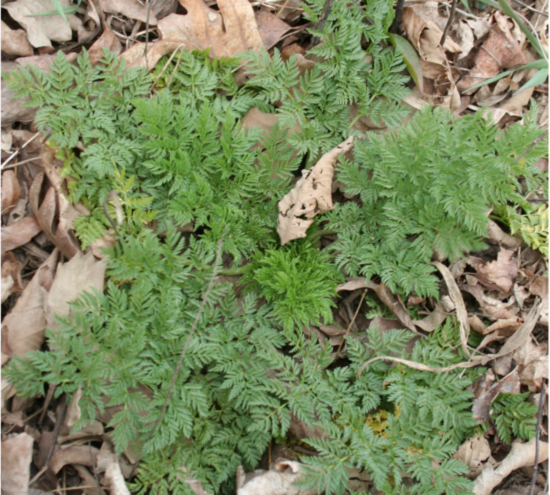 |
Image 1. Photo of a green and growing poison hemlock plant in a roadside ditch taken on March 7, 2012 in central Indiana. |
Poison Hemlock is a biennual weed that exists as a low growing herb in the first year and bolts to three to eight feet tall in the second year and produces flowers and seed. It is often not noticed or identified as a problem until the bolting and reproductive stages of the second year. The alternate compound leaves are pinnate (finely divided several times) and are usually triangular in outline. Flowers are white and occur in an umbel inflorescence. Poison hemlock is often confused with wild carrot but can be distinguished by its lack of hairs and purple blotches that occur on the stems.
Toxic Properties
Poison hemlock contains five alkaloids that are toxic to humans and livestock if ingested and can be lethal. All parts of the plants contain the toxic alkaloids with levels being variable throughout the year. Symptoms of toxicity include nervousness, trembling, and loss of coordination followed by depression, coma, and/or death. Initial symptoms will occur within a few hours of ingestion.
Cases of poisoning due to poison hemlock ingestion are rare as the plants emit a mousy odor that makes it undesirable and unpalatable to livestock and humans. Consumption and toxicity in animals usually occurs in poorly managed or overgrazed pastures where animals are forced to graze poison hemlock.
Control
Control of poison hemlock with herbicide is most effective when applied to plants in the first year of growth or prior to bolting and flowering in the second year. The closer to reproductive stages, the less effective the herbicide. In roadside ditches, pastures, and waste areas, herbicides containing triclopyr (Remedy Ultra) or triclopyr plus 2,4-D (Crossbow) are most effective in controlling poison hemlock. Other herbicides that provide adequate control when applied at the proper timing are dicamba (Clarity, Banvel), metsulfuron-methyl (Cimarron, Escort XP), metsulfuron-methyl plus dicamba (Cimarron Max) and clopyralid plus 2,4-D (Curtail).
For information on control of poison hemlock in corn and soybean please refer to a previous Purdue Weed Science article: Poison Hemlock Control in Corn and Soybeans.
For further information on toxic plants in Indiana refer to the Purdue University Weed Science Guide to Toxic Plants in Forages
Thursday, May 10, 2012
Black Cutworm Flocks to Indiana; Scouting Proves Critical
Record numbers of black cutworm moths have descended upon Indiana fields, and after a week of warm temperatures and rainfall now is a critical time to scout, a Purdue Extension entomologist says.
Pheromone trap cooperators throughout the state monitor for the insect's arrival, which has the potential to cause significant economic damage to field crops. A round of storms originating in southern states in March brought not only rain to Indiana, but cutworm populations not previously seen. Since that time additional captures have had the trappers very busy counting.
According to John Obermeyer, the key to successfully controlling the insect is to scout early and often and to apply insecticides when larvae are small - especially because large larvae are difficult to control. <Read More>
Pheromone trap cooperators throughout the state monitor for the insect's arrival, which has the potential to cause significant economic damage to field crops. A round of storms originating in southern states in March brought not only rain to Indiana, but cutworm populations not previously seen. Since that time additional captures have had the trappers very busy counting.
According to John Obermeyer, the key to successfully controlling the insect is to scout early and often and to apply insecticides when larvae are small - especially because large larvae are difficult to control. <Read More>
Wednesday, May 9, 2012
Buttercup Bonanza
 |
| Buttercup in pasture (The Buttercups of Indiana) |
The name buttercup is actually a common name associated with approximately 20 different weed species that are found in Indiana. To complicate matters further, petal number and leaf appearance can vary within the same species, occasionally making exact identification difficult.
The main concern with buttercup, regardless of species, is its toxicity to livestock. While the amount required to be consumed to cause poisoning symptoms varies among species, all have the potential to cause drooling, diarrhea, weakness, bleeding, etc. The good news is livestock rarely consume the weed, especially if there is an adequate supply of desirable forage. Also, buttercup toxicity does not carry through to hay crops due to the break down of the toxins as the hay dries.
Control of buttercup can be accomplished through a combination of soil testing/soil amending, mowing, and herbicide applications. Additional information on buttercup biology and control, including specific herbicide recommendations, can be found in the Purdue Weed Science bulletin, The Buttercups of Indiana.
In The Grow - Q & A
Q. What is the best way to eradicate henbit? Would a
weed-and-feed in fall or spring be most effective? Would a spray weed killer be
most effective in spring or fall? Could you use a pre-emergence like crabgrass
preventer in the fall?
A. Henbit is a winter annual, meaning it germinates from seed in the fall, overwinters in a dormant state and then blooms and sets seed to complete its lifecycle in late winter/early spring. By mid- to late spring, the foliage will turn yellow, but if allowed to remain until then, it will have produced a lot of seed to germinate in years to come. <Read More>
A. Henbit is a winter annual, meaning it germinates from seed in the fall, overwinters in a dormant state and then blooms and sets seed to complete its lifecycle in late winter/early spring. By mid- to late spring, the foliage will turn yellow, but if allowed to remain until then, it will have produced a lot of seed to germinate in years to come. <Read More>
Tuesday, April 17, 2012
What's Growing in my Pond??!! - Part 2
In a previous post, I described various preventive measures for aquatic vegetation control. While these measures will help prevent weed growth, they are not the answer for eliminating weed infestations that are already present. If this is the case, there are various mechanical, biological, and chemical methods available to control aquatic weeds.
Mechanical control involves physically removing the plants. This can be done by hand or with special hand-held devices designed for cutting and pulling pond vegetation, available from aquatic/fisheries suppliers. Most aquatic plants are perennial and will re-sprout if the plant is not entirely removed, including growth below the ground. For larger bodies of water, motor-driven underwater vegetation harvesters are available. This equipment is a major investment and is not a feasible option for most individuals on privately owned lakes and ponds.
In severe cases of emergent plant growth, such as cattails, complete removal with a backhoe or other equipment may be necessary.
Biological control refers to the use of organisms to control vegetation. Biological control of aquatic vegetation has received considerable publicity recently and research is currently being conducted to determine the ability of bacteria, fungi, and insects to control aquatic plant infestations. The research has shown some potential but it is too early to tell if this type of control will work on a widespread scale.
The most widely used biological control is grass carp. Grass carp consume some algae and most submersed plants but have the potential to completely remove all underwater vegetation in a body of water. Grass carp can provide good control of pond vegetation but they have a tendency to feed on beneficial native plants before the truly troublesome weeds, such as Eurasian watermilfoil or mat-forming algae. Also, their feeding rate slows after about five years, so more fish may need to be added. Grass carp are not effective controls for duckweed or watermeal.
Private landowners in Indiana do not need a permit to introduce grass carp into their ponds but there are restrictions. First, the fish must be purchased from a holder of an aquaculture permit and the permit holder must deliver and stock the fish. Next, the land surrounding the pond or lake must be totally in private ownership. Finally, precautions must be taken to ensure the fish do not escape the stocked area, such as erecting barriers at the spillways and outflows.
Chemical control is the most common method of aquatic plant control. A variety of chemicals are available to control different types of vegetation. When used properly, chemical controls are safe and effective. However, many are only temporary solutions and require repeated applications to prevent the vegetation from returning. When using chemical controls, read and follow all label directions. The type of chemical required depends on the type of vegetation you want to control. Many chemicals also have waiting periods on the use of water treated with the herbicides. These mostly have to do with fishing, domestic use, livestock watering, and irrigation.
The best time to apply aquatic herbicides is late spring. Do not wait until July or August. Late summer treatments can kill fish. By that time of year, vegetation is extensive and thick and the water is warm. Killing off vegetation under these conditions seriously depletes oxygen levels in the water and can result in fish kills. If you must treat in late summer, treat only a portion of the vegetation at a time.
Additional information on aquatic weed control, including specific herbicide recommendations, can be found in Purdue Extension Publication APM-3, Identifying and Managing Aquatic Vegetation.
Mechanical control involves physically removing the plants. This can be done by hand or with special hand-held devices designed for cutting and pulling pond vegetation, available from aquatic/fisheries suppliers. Most aquatic plants are perennial and will re-sprout if the plant is not entirely removed, including growth below the ground. For larger bodies of water, motor-driven underwater vegetation harvesters are available. This equipment is a major investment and is not a feasible option for most individuals on privately owned lakes and ponds.
In severe cases of emergent plant growth, such as cattails, complete removal with a backhoe or other equipment may be necessary.
Biological control refers to the use of organisms to control vegetation. Biological control of aquatic vegetation has received considerable publicity recently and research is currently being conducted to determine the ability of bacteria, fungi, and insects to control aquatic plant infestations. The research has shown some potential but it is too early to tell if this type of control will work on a widespread scale.
The most widely used biological control is grass carp. Grass carp consume some algae and most submersed plants but have the potential to completely remove all underwater vegetation in a body of water. Grass carp can provide good control of pond vegetation but they have a tendency to feed on beneficial native plants before the truly troublesome weeds, such as Eurasian watermilfoil or mat-forming algae. Also, their feeding rate slows after about five years, so more fish may need to be added. Grass carp are not effective controls for duckweed or watermeal.
Private landowners in Indiana do not need a permit to introduce grass carp into their ponds but there are restrictions. First, the fish must be purchased from a holder of an aquaculture permit and the permit holder must deliver and stock the fish. Next, the land surrounding the pond or lake must be totally in private ownership. Finally, precautions must be taken to ensure the fish do not escape the stocked area, such as erecting barriers at the spillways and outflows.
Chemical control is the most common method of aquatic plant control. A variety of chemicals are available to control different types of vegetation. When used properly, chemical controls are safe and effective. However, many are only temporary solutions and require repeated applications to prevent the vegetation from returning. When using chemical controls, read and follow all label directions. The type of chemical required depends on the type of vegetation you want to control. Many chemicals also have waiting periods on the use of water treated with the herbicides. These mostly have to do with fishing, domestic use, livestock watering, and irrigation.
The best time to apply aquatic herbicides is late spring. Do not wait until July or August. Late summer treatments can kill fish. By that time of year, vegetation is extensive and thick and the water is warm. Killing off vegetation under these conditions seriously depletes oxygen levels in the water and can result in fish kills. If you must treat in late summer, treat only a portion of the vegetation at a time.
Additional information on aquatic weed control, including specific herbicide recommendations, can be found in Purdue Extension Publication APM-3, Identifying and Managing Aquatic Vegetation.
Wednesday, April 11, 2012
What's Growing in my Pond??!! - Part 1
 |
| Blue-green algae bloom (Held) |
 |
| Blue-green algae bloom, closeup (Held) |
 |
| American pondweed (APM-3) |
Many pond weeds or their seeds are carried into a body of water by wind, birds, fish introduction, boat trailers, fishing, etc. Prevention starts with reducing or eliminating the causes of the spread; i.e. discouraging geese from visiting your pond, washing plant fragments off boat trailers and boats before moving to a new site, and removing plant fragments when moving fish or fish bait from one site to another.
A newly introduced weed will become a problem only if water conditions are just right. Good growing conditions usually mean the body of water is shallow or has shallow areas with good light penetration, and has an available source of nutrients (nitrogen and phosphorous) either in the water or stored in the sediment. Often nutrients enter a pond from runoff or stream flow. In addition to monitoring and reducing or eliminating nutrient and sediment sources in the watershed, the following steps can be taken to help prevent weed growth.
First, do not fertilize the pond or lake. In the Midwest, most waters are sufficiently rich in food organisms to feed large fish without being fertilized. Next, maintain a good sod and grass cover around the pond or areas that drain into the water. This will help absorb nutrients that might flow into the water as well as help control erosion. It is also thought that taller vegetation around a pond reduces the chances of Canadian geese colonizing a water site. A third step is to not apply fertilizer within 20 feet of the bank.
Livestock should not be given access to the pond except in cases of extreme heat stress. If the pond is used for livestock water, it should be fenced and the animals should be used watered using a stock tank outside the pond. Animals can add turbidity and fertility to the water and tear down the banks. It is also important to make sure run-off from feedlots or other livestock pens does not run into the pond.
Finally, a settling or retention pond or wetland area can be established to receive and settle out nutrients before the flow reaches the main body of water.
Stay tuned for Part 2.........
Subscribe to:
Posts (Atom)