Conventional wisdom says that the prime planting window to maximize corn yields in much of Indiana opens about April 20 and closes about May 10. This “window” typically opens about one week later across the northern tier of Indiana counties (later warmup) and about one week earlier across the southern tier of Indiana counties (earlier warmup).
Very little corn, if any, has been planted in Indiana yet this spring as of 14 April. By itself, this is not much cause for concern because typically only a very small percentage of acres are ever planted by this date in Indiana. However, the specter of delayed planting is clearly on the horizon because little other spring fieldwork has been completed due to the frequent and sometimes excessive rainfall in recent weeks. For some growers, tillage operations, herbicide applications, and nitrogen fertilizer applications must be completed first before they can consider planting their crops.
What are the consequences of a delayed start to planting? How important a predictor of statewide corn yield is planting date anyway? Does late planting in and of itself guarantee lower than normal yields? Good questions, but the effect of planting date on statewide average corn yield is not clearcut. <Read More>

Showing posts with label weather. Show all posts
Showing posts with label weather. Show all posts
Friday, April 19, 2013


Tuesday, March 26, 2013
Impact of Cool Temperatures on Wheat Herbicides
Jim Martin, University of Kentucky Extension Weed Scientist
The cool temperatures we experienced this spring caused some wheat growers to delay herbicide applications in anticipation of better weather. Stress conditions such as cool temps tend to limit physiological process in plants; therefore, slowing the response of weeds to the herbicide. The desired level of control may eventually be achieved; however, in some instances the slower activity may allow time for some weeds to recover. The slower activity caused by environmental stress, such as cool temperatures, may also limit wheat’s ability to metabolize herbicides, thus resulting in injury.
The immediate forecast doesn’t look favorable which prompts growers to ask “Do I spray or wait for better weather?”
The logical choice would be to wait for improved conditions if the size and number of weeds are small. However, if the size or number of weeds dictates to spray, consider an herbicide option that has the greatest margin of safety and is effective on the weeds that are present. Cool temperatures may have less of an impact on controlling weeds that are highly susceptible than those that are marginally susceptible.
The following are some tips to consider as we progress through the next few days,
• Harmony and Harmony Extra are examples of ALS- inhibitor herbicides that can injure wheat in cool wet soil conditions. Injury may also occur if wide fluctuations of day and nighttime temperatures occur prior to, or soon after, application It is not clear to what extent, if any, the injury observed for Harmony and Harmony Extra impacts wheat yield. The labels of these products recommend adding 2,4-D as a tank mix partner to limit the risk of injuring wheat from the ALS-inhibitor herbicides. It is important to recognize the safest time to use 2,4-D in wheat is when plants are fully tillered and prior to jointing.
• Some growers may be tempted to include Clarity, Banvel, or other products that contain dicamba as a tankmix partner with other herbicides to enhance control of certain broadleaf weeds. Avoid using dicamba once wheat begins to joint in order to limit the risk of injuring wheat.
• When controlling wild garlic with Harmony, Harmony Extra, or similar generic products, allow time for plants to develop 2 to 4 inches of actively growing tissue. The new growth emerges from the base of the plants and not from the old leaves that have tip burn from cold temperatures.
 |
| Snow covered wheat in late March |
The cool temperatures we experienced this spring caused some wheat growers to delay herbicide applications in anticipation of better weather. Stress conditions such as cool temps tend to limit physiological process in plants; therefore, slowing the response of weeds to the herbicide. The desired level of control may eventually be achieved; however, in some instances the slower activity may allow time for some weeds to recover. The slower activity caused by environmental stress, such as cool temperatures, may also limit wheat’s ability to metabolize herbicides, thus resulting in injury.
The immediate forecast doesn’t look favorable which prompts growers to ask “Do I spray or wait for better weather?”
The logical choice would be to wait for improved conditions if the size and number of weeds are small. However, if the size or number of weeds dictates to spray, consider an herbicide option that has the greatest margin of safety and is effective on the weeds that are present. Cool temperatures may have less of an impact on controlling weeds that are highly susceptible than those that are marginally susceptible.
The following are some tips to consider as we progress through the next few days,
• Harmony and Harmony Extra are examples of ALS- inhibitor herbicides that can injure wheat in cool wet soil conditions. Injury may also occur if wide fluctuations of day and nighttime temperatures occur prior to, or soon after, application It is not clear to what extent, if any, the injury observed for Harmony and Harmony Extra impacts wheat yield. The labels of these products recommend adding 2,4-D as a tank mix partner to limit the risk of injuring wheat from the ALS-inhibitor herbicides. It is important to recognize the safest time to use 2,4-D in wheat is when plants are fully tillered and prior to jointing.
• Some growers may be tempted to include Clarity, Banvel, or other products that contain dicamba as a tankmix partner with other herbicides to enhance control of certain broadleaf weeds. Avoid using dicamba once wheat begins to joint in order to limit the risk of injuring wheat.
• When controlling wild garlic with Harmony, Harmony Extra, or similar generic products, allow time for plants to develop 2 to 4 inches of actively growing tissue. The new growth emerges from the base of the plants and not from the old leaves that have tip burn from cold temperatures.

Wednesday, October 3, 2012
Fall Frost Increases Potential for Prussic Acid Toxicity in Livestock
Fall frost is an annual concern for livestock producers because of the potential
for prussic acid poisoning, but the potential for toxicity in livestock is of
wider concern this year because of drought, an Ohio State University Extension
forage specialist says.
The drought of 2012 has been one of the worst on record, leaving many livestock producers short on hay and silage supplies. The lack of substantial rainfall, extreme heat and dryness left many producers looking for any alternative forages they could plant to make up for the shortages, Mark Sulc said. <Read More>
The drought of 2012 has been one of the worst on record, leaving many livestock producers short on hay and silage supplies. The lack of substantial rainfall, extreme heat and dryness left many producers looking for any alternative forages they could plant to make up for the shortages, Mark Sulc said. <Read More>
Wednesday, September 19, 2012
Premature Corn Kernel Sprouting (aka. Vivipary)
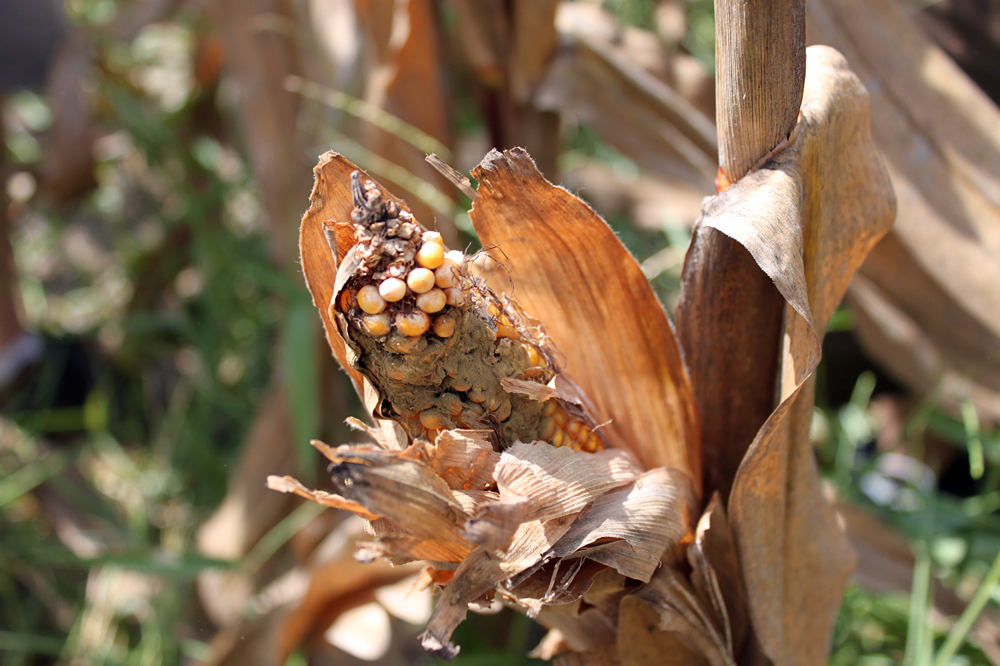
Vivipary, the premature germination or sprouting of corn kernels on the cob prior to harvest, is not a common problem in Indiana but sometimes can be serious enough to warrant attention from growers. Technically, the fact that corn kernels have the ability to germinate and develop into seedlings is not odd. Yet, when such sprouting occurs while immature or mature kernels are still attached to the cob, we consider it odd and assign a fancy name to it to reinforce the fact that we consider it odd. On the rare occasion when viviparous germination occurs throughout a field to a large enough degree, overall grain quality can deteriorate enough to cause problems with drying and storage of grain. Another consequence is the potential increase in the percentage of "broken corn and foreign material" in affected grain delivered to the elevator that may result in significant grain price discounts to the grower. <Read More>
Tuesday, September 18, 2012
New Aspergillus Ear Rot Brochure
 |
| Aspergillus Ear Rot (Purdue University/Woloshuk) |
Weekly Outlook - Early Corn Harvest and September 1 Stocks
A larger percentage of the U.S. corn grain acreage was harvested in August this year than is typically the case. The availability of large new crop corn supplies during the last month of the previous marketing year makes it more difficult to anticipate the magnitude of old crop stocks on September 1.
According to the USDA’s weekly Crop Progress report, 6 percent of the corn acreage in the 18 major producing states was harvested as of August 26 and 10 percent was harvested as of September 2, implying about 9 percent of the acreage was harvested by the end of August. Harvest progress by the end of August last year, and the average for the previous 5 years, was about 2.5 percent. If the average yield of the harvested acreage this year was near the average of 122.8 bushels forecast for the U.S, then about 965 million bushels were likely harvested in August, compared to about 310 million bushels likely harvested in August last year. <Read More>
In the Grow - Q & A
 Q. We have had the pictured vine above our sink since 1977. It has never
bloomed in all that time - until this spring. It bloomed for the very first
time. We don't know the name of the vine and would like to know. Our daughter
told us it is a common vine. What can you tell us?
Q. We have had the pictured vine above our sink since 1977. It has never
bloomed in all that time - until this spring. It bloomed for the very first
time. We don't know the name of the vine and would like to know. Our daughter
told us it is a common vine. What can you tell us? A. Wax plant, known botanically as Hoya carnosa, is a popular, easy-to-grow houseplant. This vigorous, twining vine may take years before it is mature enough to bloom, but once it does, it often continues blooming for months. Wax plant performs best in bright light with a well-drained soil mix that is allowed to dry a bit between waterings. This species seems to prefer being a bit pot-bound, so don't be in too much of a hurry to repot, even if it seems overgrown for its container.
Q. I have a question about cedar and bark and any wood chips for mulch. Will these chips attract termites?
A. Mulch of any kind can create a stable, moist habitat favorable to termites, so if termites are already in the area, or happen to wander into the area, you might see them in or under the mulch while they forage. <Read More>
Thursday, August 30, 2012
Aspergillus Ear Rot in Corn
 |
| Powdery olive-green fungal spores are characteristic of Aspergillus ear rot |
As many of you have already heard, 2012 heat and drought conditions in our local corn crop have led to the on-set of Aspergillus ear rot and associated aflatoxins concerns for the local livestock industry. Lab tests for the mold locally have detected low levels in most samples, with mold levels expected to rapidly increase with recent rain activity in the area. Local mills and grain buyers will also be utilizing UV or “black lights” at most facilities to quickly detect to possibility of the mold in delivered corn, with some loads possibly to be diverted or stored separately at their facilities.
Recommendations are for local corn producers to harvest the crop as soon as possible at higher moistures before the mold has a chance to become well established, and then dry down the grain well below 15% (recommended 12-13%, depending on source). Drying will reduce the opportunity for additional aflatoxins to be produced, although this will not reduce current levels.
For silage production, aflatoxins will usually remain at the levels found in the corn at time of ensilaging if the process is done correctly at the right moisture, in air-tight conditions, correctly compacted, etc.. Where corn is not correctly made into silage (too dry or too much air around chopped corn), the mold may continue to develop and raise aflatoxin levels as fermentation is slowed or fails.
Testing can be done through the Purdue Heeke ADDL lab at the Southern Indiana Purdue Ag. Center near Dubois, IN, or through numerous testing labs available through your local feed mills.
A recent AgAnswers news article addresses the topic in more detail and and additional information on the mold, testing and preventative measures can also be found in Purdue Extension Publication BP-83.
Wednesday, August 22, 2012
September Home, Yard, and Garden Calendar
HOME (Indoor plants and activities)
Prepare storage areas for overwintering tender flower bulbs and garden produce.
Thanksgiving (or Christmas) cactus can be forced into bloom for the Thanksgiving holidays. Provide 15 hours of complete darkness each day, for instance, from 5 p.m. to 8 a.m., for approximately eight weeks. Keep temperature at about 60 to 65F. Temperatures of 55F will cause flower buds to set without dark treatment.
YARD (Lawns, woody ornamentals and fruits)
Fall is usually a good time to plant many container-grown or balled-and-burlapped nursery stock, but if your area is still suffering from drought, it might be best to wait for better conditions. You do not want new plantings to go into winter in drought condition.
If you do have sufficient rainfall or ability to irrigate new plantings, prepare a hole wider than the plant’s rootball, plant at the same depth it grew in the nursery, and water thoroughly. Mulching will help protect against large fluctuations in soil temperature and moisture. Be sure to stake or guy-wire tall plants during their first season to protect them from strong winds.
GARDEN (Vegetables, small fruits and flowers)
Dig up onions and garlic after tops fall over naturally and necks begin to dry.
Plant radishes, green onion sets, lettuce and spinach for fall harvest.
Thin out fall crops such as lettuce and carrots that were planted earlier. <Read More>
Prepare storage areas for overwintering tender flower bulbs and garden produce.
Thanksgiving (or Christmas) cactus can be forced into bloom for the Thanksgiving holidays. Provide 15 hours of complete darkness each day, for instance, from 5 p.m. to 8 a.m., for approximately eight weeks. Keep temperature at about 60 to 65F. Temperatures of 55F will cause flower buds to set without dark treatment.
YARD (Lawns, woody ornamentals and fruits)
Fall is usually a good time to plant many container-grown or balled-and-burlapped nursery stock, but if your area is still suffering from drought, it might be best to wait for better conditions. You do not want new plantings to go into winter in drought condition.
If you do have sufficient rainfall or ability to irrigate new plantings, prepare a hole wider than the plant’s rootball, plant at the same depth it grew in the nursery, and water thoroughly. Mulching will help protect against large fluctuations in soil temperature and moisture. Be sure to stake or guy-wire tall plants during their first season to protect them from strong winds.
GARDEN (Vegetables, small fruits and flowers)
Dig up onions and garlic after tops fall over naturally and necks begin to dry.
Plant radishes, green onion sets, lettuce and spinach for fall harvest.
Thin out fall crops such as lettuce and carrots that were planted earlier. <Read More>
Stressed Plants May Look Like Early Fall

Early fall color and/or defoliation is common when plants are under stress and this season has been quite challenging for many trees, both old and young. The intense heat made it difficult for plants to keep up with water and cooling requirements, even in areas where moisture was adequate. Combine extreme heat with drought, and it is a wonder any plants survive. <Read More>
Monday, August 13, 2012
Upcoming Events - Livestock and Forage Drought Management Update
The drought of 2012 has presented some unique challenges to livestock producers with regards to forage supplies and pasture condition. Purdue Extension of Dubois, Perry, Spencer, and Warrick Counties is presenting a Livestock and Forage Drought Management Update to discuss these challenges and identify management tips for this year and beyond. Specific topics include Utilizing Alternative Feeds and Forages, Forage Nitrate and Nutrient Testing, Herd Management and Feeding Techniques, and Pasture Renovation. Featured speakers will include Dr. Keith Johnson, Purdue Extension Forage Specialist and Dr. Ron Lemenager, Purdue Extension Beef Specialist.
The update will be held August 16 at 6:30 PM CDT at the St. Meinrad Community Center. The update is free-of-charge but pre-registration is requested by August 13. For more information, or to register, please contact the Spencer County Purdue Extension Office at (812) 649-6022 or nheld@purdue.edu.
The update will be held August 16 at 6:30 PM CDT at the St. Meinrad Community Center. The update is free-of-charge but pre-registration is requested by August 13. For more information, or to register, please contact the Spencer County Purdue Extension Office at (812) 649-6022 or nheld@purdue.edu.
Tuesday, July 31, 2012
Forage Crops Could Provide Opportunities Following Corn
A wide range of forage crops could help grain and livestock producers salvage some value from their fields once the drought-ravaged corn crop has been harvested - if soil moisture returns to a level that can support plant growth.
While damaged corn can be used as forage to feed livestock, it won't be enough to thwart forage shortages. Several forage crops are available for Indiana growers to plant in late summer or early fall, and that could serve as livestock feed in the spring.
"For the August seeding, an excellent consideration would be spring oat that will be harvested by machine, or a combination of spring oat and forage turnip if grazed by livestock," said Keith Johnson, Purdue Extension forage specialist. "Spring oat will not survive the winter.
"While the expectation is for turnips to winterkill, too, it has been observed that they can survive a mild Indiana winter."
Another possible choice is annual ryegrass, but growers who go this route need to pay close attention to keep the crop from becoming a nuisance. Johnson recommended an early seeding to have both fall and spring harvests. <Read More>
While damaged corn can be used as forage to feed livestock, it won't be enough to thwart forage shortages. Several forage crops are available for Indiana growers to plant in late summer or early fall, and that could serve as livestock feed in the spring.
"For the August seeding, an excellent consideration would be spring oat that will be harvested by machine, or a combination of spring oat and forage turnip if grazed by livestock," said Keith Johnson, Purdue Extension forage specialist. "Spring oat will not survive the winter.
"While the expectation is for turnips to winterkill, too, it has been observed that they can survive a mild Indiana winter."
Another possible choice is annual ryegrass, but growers who go this route need to pay close attention to keep the crop from becoming a nuisance. Johnson recommended an early seeding to have both fall and spring harvests. <Read More>
Heat and Drought Lead to Ear Rot Potential in Corn Grain, Silage
Heat and drought in the Corn Belt have created the perfect conditions for Aspergillus ear rot to develop in corn grain and silage - something Purdue Extension plant pathologists say grain and livestock producers need to prepare for.
The disease is caused by a fungus that produces aflatoxin, a toxic carcinogen for livestock that consume contaminated grain or silage.
Aspergillus ear rot normally shows up near the end of the corn growing season as the crop reaches the dent phase. Growers can identify the disease by peeling back the husks and looking for stunted ears with an olive-green dusty mold. <Read More>
The disease is caused by a fungus that produces aflatoxin, a toxic carcinogen for livestock that consume contaminated grain or silage.
Aspergillus ear rot normally shows up near the end of the corn growing season as the crop reaches the dent phase. Growers can identify the disease by peeling back the husks and looking for stunted ears with an olive-green dusty mold. <Read More>
Friday, July 27, 2012
Early Weaning as a Drought Strategy
In addition to utilizing alternative forages and feedstuffs, early weaning and other herd management techniques can be effective drought management strategies for livestock producers. The Purdue Animal Sciences Department recently created a video featuring Dr. Ron Lemenager discussing early weaning in times of drought and short forage supplies. The video is available here.
Thursday, July 12, 2012
Purdue Extension Drought Press Conference
On July 5, Purdue Extension held a drought press conference at the Indiana State Fairgrounds. Extension Specialists and Educators addressed a variety of drought-related topics and answered questions from media. To view the press conference, please see the video link below:
A news release highlighting the topics of discussion at the press conference is also available here.
Blossom End Rot - Another Drought Effect
 |
| Blossom-end rot on tomato (Creswell) |
The culprit is a non-infectious disorder called blossom-end rot that affects not only tomatoes but also peppers and eggplants. Symptoms of blossom end rot first show up as small, light brown or water soaked spots on the blossom end of the fruit (thus the name). As the fruit ripens, spots enlarge rapidly, forming a dark, sunken, leathery lesion on the bottom of the fruit. Sometimes the lesions will cover the entire bottom half of the fruit. Blossom end rot usually affects the first fruits of the season most severely and many times the symptoms will disappear as the season progresses. While it may appear unappetizing, the un-rotted portion of the fruit is still edible.
Blossom-end rot is caused by a lack of calcium in the fruit. In most cases, this does not mean there is a lack of calcium in the soil. Rather, there are environmental factors that affect the plant’s uptake of calcium. When the supply of calcium to the fruit does not keep up with its requirements, tissue in the fruit begins to break down. The environmental factors contributing to blossom-end rot include wide fluctuations in soil moisture levels (i.e. letting the plant reach the wilting point before watering), rapid plant growth followed by a prolonged period of dry weather, excessive rainfall which can smother roots, excessive use of nitrogen fertilizer or fresh manure, and root damage. This year's blossom-end rot occurrences most likely are due to soil moisture fluctuations and prolonged drought.
As mentioned early, rarely is the problem due to an actual soil calcium deficiency, so adding calcium to the soil is not usually an effective control method, unless recommended by a soil test. Foliar applications of calcium are also occasionally recommended, however they too are usually ineffective because the plants do not adequately absorb the calcium and get it to where it is needed most. An interesting point regarding blossom-end rot is that it usually affects the first fruits of the season most severely and once the plant's growth and calcium levels get back in balance, the symptoms disappear. So, when gardeners who have applied soil or foliar calcium, or some other home-remedy, see that the symptoms have disappeared, they mistakenly believe the calcium application was effective, when in reality, it was the plant managing the problem itself.
To reduce the chances of blossom end rot occurring, some preventive steps can be taken. First, maintain a uniform moisture level in the soil - do not let the plants dry out repeatedly. Ideally, plants should receive the equivalent of one inch of water per week via rainfall or irrigation. Second, test soil regularly to maintain proper fertility and pH levels. Next, avoid using fertilizers containing high nitrogen levels or excessive amounts of fresh manure. These materials can cause excessive growth of leaves and stems and inhibit fruit development and production. Finally, do not cultivate deeper than 1 inch within a foot of the plant to avoid root damage.
Blossom-end rot will always be annoyance for vegetable gardeners but with a few simple preventive steps, its effect on production can be greatly reduced.
Friday, June 29, 2012
In Times of Drought
Dry summers are not that unusual in the Midwest, but this year's dry spell - and
now drought in many areas - has come considerably earlier than usual. Summer is
just now officially getting started!
Gardeners have a battle on their hands to keep plants healthy when extremely high temperatures are accompanied by lack of rain. During prolonged drought conditions, water restrictions or just limited ability to water to a huge number of plants, you may have to limit watering and prioritize which plants will be rescued - a bit of garden triage, so to speak. <Read More>
Gardeners have a battle on their hands to keep plants healthy when extremely high temperatures are accompanied by lack of rain. During prolonged drought conditions, water restrictions or just limited ability to water to a huge number of plants, you may have to limit watering and prioritize which plants will be rescued - a bit of garden triage, so to speak. <Read More>
Thursday, June 28, 2012
Extreme Drought and Heat Wave - Not a Good Combination

In the previous drought post, it was noted that if upcoming rainfall chances did not materialize, we could be at a tipping point for much worse drought conditions. Well, as we all know, those weather systems did not materialize and we are seeing increasingly widespread drought effects on crops, lawns, and gardens. This week's US Drought Monitor report has placed the majority of Spencer County in the the "extreme" category and the 7-day forecast from the National Weather Service indicates 100+ degree temperatures each day with no chance of rain.
Purdue Extension and the Extension Disaster Education Network have developed a drought information website that compiles drought management tips and resources for consumers, homeowners, and agricultural producers. This site will continue to be updated with information as long as the drought conditions persist. I encourage you to check out this this regularly for updates.
Also, two articles have recently been released addressing the continued drought effects on corn and soybean production. Links to those publications are listed below:
Hot & Dry: Stress on the Corn Crop Escalates
Signs of Drought Stress in Soybeans
Friday, June 15, 2012
Drought....and the Potential for More Drought
 |
| US Drought Monitor report for Indiana. For more information, see the Drought Monitor website. |
So far, Spencer County has fared better than our neighbors to the west and northwest. Though we are in the moderate drought category, infrequent but timely rainfall, combined with cooler temperatures, especially overnight, have kept drought effects in crops, gardens, and home landscapes from becoming widespread.
There is a slight chance of scattered showers this weekend but according to staff at the Indiana State Climate Office, the next chance for more widespread, substantial rainfall is not until late next week. As a result, we are in a bit of a wait-and-see pattern as far as how the drought will progress, with the next 10-14 days being crucial. If one or both of these predicted systems produce rainfall, it could be just the timely rain event we need to hold off further drought progression, at least for a few more weeks. However, if these systems fail to bring moisture, we could then be at the tipping point for something much more severe.
As we watch how the situation progresses over the next two weeks, we will continue to post drought management information on the Gazette, on our Facebook page, and in our bi-monthly newsletter. In the meantime, below are two articles addressing the topic. The first is a recent article covering the effects we are currently seeing in corn and soybean crops. The second, originally written in 2007, covers tips for home gardens and landscapes.
More Crops Affected as Drought Spreads Throughout Indiana
Help Your Garden Cope with Dry Spell
Subscribe to:
Posts (Atom)