This spring so far has been cold and wet with short spurts of warm sunny days in-between. This weather cycle for the most part kept producers out of field and allowed the winter annual weeds to flourish the past couple of weeks. As we look ahead to the next couple of weeks in hope of getting out to the fields to do spring no-till burndown applications, there are a couple of things to keep in mind. <Read More>

Showing posts with label corn. Show all posts
Showing posts with label corn. Show all posts
Friday, April 19, 2013


The Planting Date Conundrum for Corn
Conventional wisdom says that the prime planting window to maximize corn yields in much of Indiana opens about April 20 and closes about May 10. This “window” typically opens about one week later across the northern tier of Indiana counties (later warmup) and about one week earlier across the southern tier of Indiana counties (earlier warmup).
Very little corn, if any, has been planted in Indiana yet this spring as of 14 April. By itself, this is not much cause for concern because typically only a very small percentage of acres are ever planted by this date in Indiana. However, the specter of delayed planting is clearly on the horizon because little other spring fieldwork has been completed due to the frequent and sometimes excessive rainfall in recent weeks. For some growers, tillage operations, herbicide applications, and nitrogen fertilizer applications must be completed first before they can consider planting their crops.
What are the consequences of a delayed start to planting? How important a predictor of statewide corn yield is planting date anyway? Does late planting in and of itself guarantee lower than normal yields? Good questions, but the effect of planting date on statewide average corn yield is not clearcut. <Read More>
Very little corn, if any, has been planted in Indiana yet this spring as of 14 April. By itself, this is not much cause for concern because typically only a very small percentage of acres are ever planted by this date in Indiana. However, the specter of delayed planting is clearly on the horizon because little other spring fieldwork has been completed due to the frequent and sometimes excessive rainfall in recent weeks. For some growers, tillage operations, herbicide applications, and nitrogen fertilizer applications must be completed first before they can consider planting their crops.
What are the consequences of a delayed start to planting? How important a predictor of statewide corn yield is planting date anyway? Does late planting in and of itself guarantee lower than normal yields? Good questions, but the effect of planting date on statewide average corn yield is not clearcut. <Read More>
Monday, March 25, 2013
Winter Temperatures, Corn Flea Beetle Survival, and Potential for Stewart’s Wilt
- Corn flea beetle winter survival is expected to be low in northern and central Indiana.
- Moderate survival is expected for southern Indiana, higher in the Ohio River valley.
- Corn flea beetle is a vector of Stewart’s bacterial wilt and leaf blight of corn.
- Seed applied insecticides generally prevent early corn flea beetle feeding.
Corn flea beetle is a sporadic corn pest in Indiana and has had little impact of recent years. Still, winter temperatures in regions where beetles were abundant last season will determine if there is cause to be concerned this spring for susceptible inbreds and hybrids. This is especially important since this insect transmits the bacterium that causes Stewart’s disease in corn. The severity of the disease correlates with last season’s beetle abundance and this winter’s temperatures. This is because the Stewart’s wilt bacterium survives in the gut of the overwintering beetles and depends upon the beetle to infect corn. Warmer temperatures result in higher beetle survival, and therefore a greater potential for Stewart’s disease. <Read More>
Tuesday, January 29, 2013
Upcoming Event - Area Corn and Soybean Day
Purdue Extension Educators from southwest Indiana are
hosting an Area Corn & Soybean Day for grain producers interested in
receiving agronomic, as well as, a local grain market update. The event is being held on Tuesday, February
5th at the Vanderburgh County Fairgrounds Activities building,
beginning with registration at 8:00 AM CST.
Purdue University Agronomy Specialists Bob Nielsen, Shaun
Casteel and Jim Camberato will be the featured speakers on corn, soybeans and
fertilizer topics. In addition,
representatives from area grain elevators will conduct a panel discussion on
grain marketing issues. PARP, CCH, and CEU credit is available.
A complete list of speakers and topics is
available here.
Weekly Outlook - Update on Corn Consumption
March 2013 corn futures are currently trading about .25 above the closing price on January 10 and about .10 below the high reached on January 16. The spot market basis also remains very strong in most markets. The USDA’s Grain Stocks report released on January 11 confirmed that feed and residual use of corn from June through November 2012 had been large, implying that consumption had not been sufficiently rationed following the small crop of 2012.
On-going changes in livestock production are mixed, but may be contributing to a slightly slower pace of feed consumption. The number of cattle in feedlots continues to be well below the level of a year ago as a result of the multi-year liquidation of the cow herd. The number of cattle on feed on January 1, 2013 was 5.6 percent below the inventory of a year earlier, about the same magnitude of decline reported on December 1, 2012. Placements into feedlots during December were only 0.7 percent less than during December 2011. <Read More>
On-going changes in livestock production are mixed, but may be contributing to a slightly slower pace of feed consumption. The number of cattle in feedlots continues to be well below the level of a year ago as a result of the multi-year liquidation of the cow herd. The number of cattle on feed on January 1, 2013 was 5.6 percent below the inventory of a year earlier, about the same magnitude of decline reported on December 1, 2012. Placements into feedlots during December were only 0.7 percent less than during December 2011. <Read More>
Friday, January 18, 2013
Weekly Outlook - USDA Reports Provide Some Price Direction
On January 11, the USDA released a series of reports that
provide important fundamental information for the crop markets. The information
included the final estimate of the size of the 2012 U.S. corn and soybean crops,
estimates of December 1 crop inventories, a winter wheat seedings estimate, and
updated U.S. and world supply and consumption forecasts for the current
marketing year.
For corn, the 2012 U.S. crop is estimated at 10.78 billion
bushels, 55 million larger than the November forecast. The estimate of planted
acreage of corn for all purposes was increased by 209,000 acres, the estimate of
acreage harvested for grain was reduced by 346,000 acres, and the yield estimate
was increased by 1.1 bushels per acre. The production estimate was larger than
the pre-report average trade guess of just over 10.6 billion bushels, but the
estimate of December 1, 2012 stocks of corn was actually much smaller than the
average guess. <Read More>
Thursday, December 20, 2012
Weekly Outlook - Difficult to Anticipate Dec. 1 Corn Stocks Estimate
The USDA’s estimate of December 1, 2012 inventories of
corn, to be released on January 11, 2013, will be one of the more important
factors influencing the price of old crop corn in the first quarter of the new
year. The estimate of soybean stocks may be somewhat less important because
more is known about the level of consumption during the first quarter of the
2012-13 marketing year.
For soybeans, consumption during the first quarter of the marketing year is generally known because periodic export and crush estimates are available. Based on Census Bureau estimates for September and October and USDA inspection estimates through November, exports were near 613 million bushels. That would be slightly less than the record large exports of two years ago. Based on estimates from the National Oilseed Processors Association, the domestic crush during the first quarter was near 448 million bushels, the largest in five years. <Read More>
For soybeans, consumption during the first quarter of the marketing year is generally known because periodic export and crush estimates are available. Based on Census Bureau estimates for September and October and USDA inspection estimates through November, exports were near 613 million bushels. That would be slightly less than the record large exports of two years ago. Based on estimates from the National Oilseed Processors Association, the domestic crush during the first quarter was near 448 million bushels, the largest in five years. <Read More>
Choosing Corn Hybrids for 2013
Hybrid selection is one of the most important management decisions a corn grower makes each year. It’s a decision that warrants a careful comparison of performance data. It should not be made in haste or based on limited data. Planting a marginal hybrid, or one not suitable for a particular production environment, imposes a ceiling on the yield potential of a field before it has been planted. In the Ohio Corn Performance Test (OCPT) (http://www.oardc.ohio-state.edu/corntrials/) it is not unusual for hybrid entries of similar maturity to differ in yield by 80 bu/A, or more, depending on test site.
Growers should choose hybrids best suited to their farm operation. Corn acreage, previous crop, soil type, tillage practices, desired harvest moisture, and pest problems determine the relative importance of such traits as drydown, insect and disease resistance, herbicide resistance, early plant vigor, etc. End uses of corn should also be considered - is corn to be used for grain or silage? Is it to be sold directly to the elevator as shelled grain or used on the farm? Are there premiums available at nearby elevators, or from end users, for identity-preserved (IP) specialty corns such as food grade or non-GMO corn? Capacity to harvest, dry and store grain also needs consideration. The following are some tips to consider in choosing hybrids that are best suited to various production systems. <Read More>
Growers should choose hybrids best suited to their farm operation. Corn acreage, previous crop, soil type, tillage practices, desired harvest moisture, and pest problems determine the relative importance of such traits as drydown, insect and disease resistance, herbicide resistance, early plant vigor, etc. End uses of corn should also be considered - is corn to be used for grain or silage? Is it to be sold directly to the elevator as shelled grain or used on the farm? Are there premiums available at nearby elevators, or from end users, for identity-preserved (IP) specialty corns such as food grade or non-GMO corn? Capacity to harvest, dry and store grain also needs consideration. The following are some tips to consider in choosing hybrids that are best suited to various production systems. <Read More>
Tuesday, December 11, 2012
Weekly Outlook - Will Corn and Soybean Prices Return to Pre-drought Levels?
March 2013 corn futures dropped below $5.50 in early May 2012
and were drifting lower when U.S. drought conditions turned prices higher
starting in mid-June. The price of that contract peaked in early August, just
short of the $8.50 mark. March 2013 soybean futures dropped below $11.50 in
December 2011before South American drought conditions and then U.S. drought
conditions sent that contract above $17.25 by mid-September 2012.
Corn prices have declined by more than $1.00 since the late
summer peak, while soybean prices have declined by more than $3.00. The general
expectation has been that prices of both commodities would return to pre-drought
levels as early as 2013 as consumption adjusted to the lower supplies and as
production rebounded in both South America and the U.S. The futures market
currently reflects expectations that corn prices will moderate substantially
from current levels by the fall of 2013 as larger crops are harvested in
Argentina and then in the U.S. December 2013 futures, for example, are priced
$.95 below December 2012 futures. The soybean market expects prices to moderate
from current levels by the summer of 2013 as a large South American crop is
harvested. August 2013 futures prices are nearly $.60 lower than March 2013
prices. Further price reductions are expected into the fall of 2013 as a larger
U.S. crop is harvested. November 2013 futures are about $0.85 below the price
of August 2013 futures. Still, the prices of both commodities for delivery in
the 2013-14 marketing year are well above the levels prior to the drought of
2012. <Read More>
Wednesday, December 5, 2012
Continued Support for Corn Prices
Corn prices peaked in August, moved sharply lower in
September, and have been in a sideways pattern over the past two months. Within
that sideways pattern, prices have moved higher over the past two weeks, with
March 2013 futures trading within $0.10 of the post-September high. The recent
rally has been fueled by some supply concerns and more optimism about near-term
demand.
There are two concerns about potential supply of corn in
2013. First, the on-going wet weather in Argentina may reduce the magnitude of
planted area of corn relative to intentions. Fewer acres would threaten the
projected rebound in production. The USDA has forecast the 2013 harvest at a
record 1.1 billion bushels, a third larger than the drought-reduced harvest of
earlier this year. The USDA will update the forecast in the monthly World
Agricultural Production report to be released on December 11, but a large
change in that forecast is not expected this early in the season. During last
year’s drought, the forecast of production was not reduced in December, but was
reduced sharply in January and again in February. The potential implications of
wet weather on acreage and yield are even more difficult to discern than the
implications of drought conditions. <Read More>
Tuesday, November 13, 2012
Upcoming Event - Ohio Valley Precision Ag Conference
Purdue Extension and University of Kentucky Extension will jointly host a Nov. 29 conference to teach farmers more about how precision agriculture systems could improve their bottom lines.
The Ohio Valley Precision Ag Conference will run from 9 a.m. to 2:30 p.m. (CST) at the Vanderburgh County 4-H Fairgrounds, 201 E. Boonville-New Harmony Road, Evansville. It will cover data management, implement systems technologies, and systems calibration and setup. It also will feature local precision agriculture companies and projects.
"The variety of technologies that farmers and industry representatives have to evaluate for on-farm use is staggering," said Kenneth Eck, Purdue Extension educator in Dubois County. "This conference will give folks a better understanding of what systems are available, how emerging technologies might mesh with producers' current systems, and how both farmers and agribusinesses can manage farm data for improved economic and environmental results."
The conference will start with a presentation titled "Data Utilization and Management with Precision Tools" by Betsy Bower and Troy Walker of Ceres Solutions.
Morning breakout sessions are:
- "RTK Accuracy" by Tim Stombaugh, associate professor of biosystems and agricultural engineering at the University of Kentucky.
- "Calibration Basics - John Deere" by Ben Carlisle, Wright-Stemle John Deere.
- "Variable Rate Seeding - Can You Do It and Do You Need To?" by Bob Nielsen, Purdue Extension agronomist.
Afternoon breakout sessions are:
- A repeat of Stombaugh's "RTK Accuracy."
- "Calibration Basics – Trimble/Case IH" by Kevin Roy and Kristina Nadin, Hopf Equipment Case IH.
- "Economics of Investing or Upgrading: Old vs. New" by Greg Halich, associate Extension professor of agricultural economics at the University of Kentucky.
The conference also will feature a farmer panel discussion titled "What Do We Do With the Data and How is It Managed?" The keynote presentation will be "Precision Planting" by Gregg Sauder of Precision Planting Inc.
"This is the first time we've pulled together a program with so much of our expertise in one place," Eck said.
Conference registration is free, but reservations are required by Nov. 19. Participants can register online at http://tinyurl.com/pukyregister or by contacting any of the sponsoring Purdue Extension or University of Kentucky Extension county offices. Those counties in Indiana are Daviess, Dubois, Knox, Perry, Pike, Posey, Spencer, Vanderburgh and Warrick. In Kentucky they are Daviess, Henderson, McLean, Ohio, Union and Webster.
A flyer for the program is available here.
Weekly Outlook - Corn and Soybean Prices Following Short-crop Pattern
The USDA’s November forecasts of the size of the 2012 U.S.
corn and soybean crops were larger than expected, particularly for soybeans. As
a result, the general downtrend in soybean prices since mid-September has
accelerated, with January futures now at the lowest level since June 29. Corn
prices have moved into the lower half of the trading range that has been in
place since mid-September and December futures are at the lowest level since
September 28. So far, prices seem to be following the classic pattern
associated with small crops –peaking early in the marketing year and then
declining as the year progresses.
The futures market reflects expectations that prices will
continue to decline, especially into the 2013-14 marketing year. The expected
rebound in South American soybean production, Argentine corn production, and
U.S. corn and soybean production in 2013 all contribute to the expectation of
lower prices. If those crops are as large as generally expected, prices will be
even lower than currently reflected in the futures market. The USDA is
forecasting record South American production of both crops. If planted acreage
of corn in the U.S. in 2013 is at the same level as in 2012 and the U.S. average
yield is near a trend value of 162.5 bushels, the crop would total 14.6 billion
bushels, about 1.5 billion larger than the record crop and record consumption of
the 2009-10 marketing year. <Read More>
Thursday, November 1, 2012
Weekly Outlook - Monitoring Corn Consumption
The price of corn, like the price of other commodities, is
influenced by a wide array of factors that reflect a combination of current and
expected supply and consumption. The market continually judges whether the
price of corn is adequate to ration the available supply. While expectations
about demand over the course of the marketing year influence that judgment, the
on-going pace of consumption reveals the adjustments that are being made to
accommodate the available supply. A pace of consumption that cannot be
supported implies the need for higher prices, while a slower pace than required
implies the need for lower prices.
In the current marketing year, the small U.S. crop requires a
substantial reduction from the level of consumption in the 2011-12 marketing
year. Based on the current forecast of the crop size, imports of 75 million
bushels, and the assumption that year-ending stocks cannot be reduced below
about five percent of consumption, corn consumption during the current marketing
year will be limited to about 11.2 billion bushels. That is 1.326 billion
bushels (10.6) percent less than consumed in the previous marketing year. The
USDA has forecast a decline in consumption of 1.376 billion bushels and
year-ending stocks slightly above five percent of consumption. By category,
the USDA has forecast that exports will decline by 393 million bushels (25.5
percent), corn for ethanol and by-products will decline by 500 million bushels
(10 percent), other processing uses will decline by 71 million bushels (5
percent), and feed and residual use will decline by 412 million bushels (9
percent). <Read More>
Friday, October 19, 2012
Weekly Outlook - Beyond the October Production Forcasts for Corn and Soybeans
At 10.706 billion bushels, the USDA’s October forecast of the
U.S. corn crop was about 100 million bushels larger than the average trade guess
and about equal to the September forecast. The October soybean forecast, at
2.86 billion bushels was about 90 million bushels larger than the average trade
guess and 126 million larger than the September forecast. Prices of both
commodities increased immediately after the forecasts were released.
The positive response to what appeared to be neutral to
negative production forecasts suggest that the market had priced in the risk of
even larger production forecasts. In addition the USDA forecast year ending
stocks of both commodities to be near pipeline levels, and smaller than expected
in the case of corn. In the case of soybeans, the projection of marketing year
consumption was increased by 150 million bushels. Some interpreted the increase
as a reflection of stronger demand than had been previously forecast. <Read More>
Friday, October 12, 2012
Weekly Outook - Corn and Soybean Prices Searching for Support
December 2012 corn futures declined by $1.44 (17 percent)
from the high on August 10 to the recent low on September 28. That contract has
managed a recovery of about $0.40 so far this month. November 2012 soybean
futures declined by $2.85 (16 percent) from the high on September 4 to the low
on October 3 and have rebounded about $0.45 since then.
Prices over the past two months for corn and the past month
for soybeans appear to be in the classic “short crop, long tail” pattern where
prices peak early in a year of sharply lower production and then decline in the
post-harvest period as the smaller supplies get rationed and production rebounds
in the following year. A change in the trend of lower prices will require an
additional supply shock or evidence that supplies have not been sufficiently
rationed. <Read More>
Wednesday, October 3, 2012
Plant Pathologist: Wheat Planted in Corn Stubble at Risk for Head Scab
More corn acres brought on by high corn prices in recent years could tempt
winter wheat growers to plant the crop into corn stubble, but a Purdue Extension
pathologist says the practice puts wheat at risk for head scab development.
Head scab, or Fusariam head blight, is caused by the fungus Gibberella zeae, also known as Fusarium graminearum, which is harbored in corn residue. In corn, the fungus causes ear and stalk rots, and in wheat can lead to yield loss and reduced grain quality. The disease also produces a mycotoxin called deoxynivalenol, also called DON or vomitoxin, which is toxic to humans and livestock. <Read More>
Head scab, or Fusariam head blight, is caused by the fungus Gibberella zeae, also known as Fusarium graminearum, which is harbored in corn residue. In corn, the fungus causes ear and stalk rots, and in wheat can lead to yield loss and reduced grain quality. The disease also produces a mycotoxin called deoxynivalenol, also called DON or vomitoxin, which is toxic to humans and livestock. <Read More>
Wednesday, September 19, 2012
Premature Corn Kernel Sprouting (aka. Vivipary)
Vivipary, the premature germination or sprouting of corn kernels on the cob prior to harvest, is not a common problem in Indiana but sometimes can be serious enough to warrant attention from growers. Technically, the fact that corn kernels have the ability to germinate and develop into seedlings is not odd. Yet, when such sprouting occurs while immature or mature kernels are still attached to the cob, we consider it odd and assign a fancy name to it to reinforce the fact that we consider it odd. On the rare occasion when viviparous germination occurs throughout a field to a large enough degree, overall grain quality can deteriorate enough to cause problems with drying and storage of grain. Another consequence is the potential increase in the percentage of "broken corn and foreign material" in affected grain delivered to the elevator that may result in significant grain price discounts to the grower. <Read More>
Tuesday, September 18, 2012
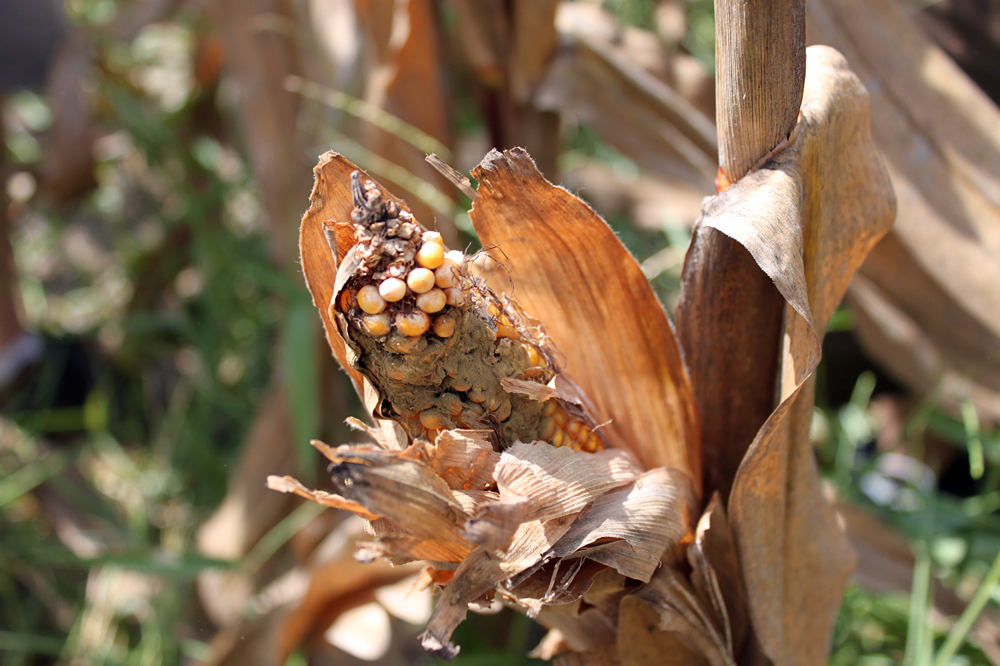
New Aspergillus Ear Rot Brochure
 |
| Aspergillus Ear Rot (Purdue University/Woloshuk) |
Weekly Outlook - Early Corn Harvest and September 1 Stocks
A larger percentage of the U.S. corn grain acreage was harvested in August this year than is typically the case. The availability of large new crop corn supplies during the last month of the previous marketing year makes it more difficult to anticipate the magnitude of old crop stocks on September 1.
According to the USDA’s weekly Crop Progress report, 6 percent of the corn acreage in the 18 major producing states was harvested as of August 26 and 10 percent was harvested as of September 2, implying about 9 percent of the acreage was harvested by the end of August. Harvest progress by the end of August last year, and the average for the previous 5 years, was about 2.5 percent. If the average yield of the harvested acreage this year was near the average of 122.8 bushels forecast for the U.S, then about 965 million bushels were likely harvested in August, compared to about 310 million bushels likely harvested in August last year. <Read More>
Wednesday, September 5, 2012
Weekly Outlook - Questions about Corn Acreage
The pace of consumption of U.S. corn has been slowing, as
evidenced by small weekly exports and export sales, smaller weekly estimates of
ethanol production, declining cattle feedlot placements, and increased slaughter
of dairy cows and the hog breeding herd. The extent of rationing required in
the current marketing year that has just begun, however, is still not clear
since the size of the 2012 crop is not yet known.
The average U.S. corn yield will obviously be the most
important factor in determining crop size, but the magnitude of acreage
harvested for grain will also influence crop size. The likely magnitude of
harvested acreage starts with the magnitude of planted acres. The USDA’s
National Agricultural Statistics Service (NASS) June Acreage report
estimated corn acreage planted for all purposes this year at 96.4 million
acres. History suggests that the final acreage estimate will deviate, at least
slightly, from this estimate. In the previous 10 years, for example, the final
estimate of planted acres deviated by as little as 37,000 to as much as 1.345
million acres from the June estimate. <Read More>
Subscribe to:
Posts (Atom)