Farm Succession Planning Series
Family farmers can get tips from Purdue University specialists on business communication and dealing with accounting and legal issues during a succession planning program offered at 10 sites in Indiana.
“Cultivating Strong Indiana Farm Family Relationships for Today and Tomorrow” will be offered in early 2013. The program is presented by Purdue’s Women in Agriculture and Farm Succession Planning teams in partnership with the North Central Risk Management Education Center.
Kelly Heckaman, Purdue Extension educator in Kosciusko County, said Indiana farmers and farm wives have asked educators for advice on handling their family businesses.
“In order to get estate planning started in families, they need to be able to communicate about it. And it’s an emotional topic, so it can be hard to get those conversations started,” Heckaman said. “The workshops will give families ideas on improving their conversations and skills to help them work through their problems and keep their families intact.”
Heckaman said the program is a collaboration between Extension and local communities, as organizers will invite local accountants and attorneys to speak on financial strategies.
The first-session agenda topics are: “A Great Year to Farm: New Farmer Financial Skills,” “The Team Approach: Working Together Through Transition” and “Communicating for Success.”
The second session’s lineup is “Business Structure and Taxes,” “The Truth about Pre- and Post-Nuptial Agreements” and “Managing Conflict.”
Registration is $50 for individuals or $100 for families up to four members. Locally, the program will be offered at the Vanderburgh Co. 4-H Fairgrounds, 201 E. Boonville New Harmony Road, Evansville, on February 19 and 26, from 8:00 AM-12:00 PM CST.
For more information, please contact Purdue Extension-Spencer County at (812) 649-6022 or nheld@purdue.edu. Registration brochures are available online.
Perry-Spencer Crop Day
The annual Perry-Spencer Crop Day program will be held Thursday, February 21 at 6:00 PM CST at the Fulda Sportsman Club. The program will feature Dr. Chuck Mansfield, Purdue Extension Agronomist, speaking on “Wheat Nutrient Management and Drought Effects on Soil Nitrogen”. The program will also feature an update on new fertilizer application regulations affecting farmers.
The cost to attend is $5.00 per person, including the meal, and is payable at the door; however pre-registration is requested by February 14. PARP and CCH credit is available for an additional $10 fee. Two CCH credits will be available in categories 1, 14, and RT.
For more information, or to register, please contact Purdue Extension-Spencer County at (812) 649-6022 or nheld@purdue.edu.

Showing posts with label drought. Show all posts
Showing posts with label drought. Show all posts
Wednesday, January 30, 2013


Tuesday, January 29, 2013
Upcoming Event - Area Corn and Soybean Day
Purdue Extension Educators from southwest Indiana are
hosting an Area Corn & Soybean Day for grain producers interested in
receiving agronomic, as well as, a local grain market update. The event is being held on Tuesday, February
5th at the Vanderburgh County Fairgrounds Activities building,
beginning with registration at 8:00 AM CST.
Purdue University Agronomy Specialists Bob Nielsen, Shaun
Casteel and Jim Camberato will be the featured speakers on corn, soybeans and
fertilizer topics. In addition,
representatives from area grain elevators will conduct a panel discussion on
grain marketing issues. PARP, CCH, and CEU credit is available.
A complete list of speakers and topics is
available here.
Thursday, December 20, 2012
Choosing Corn Hybrids for 2013
Hybrid selection is one of the most important management decisions a corn grower makes each year. It’s a decision that warrants a careful comparison of performance data. It should not be made in haste or based on limited data. Planting a marginal hybrid, or one not suitable for a particular production environment, imposes a ceiling on the yield potential of a field before it has been planted. In the Ohio Corn Performance Test (OCPT) (http://www.oardc.ohio-state.edu/corntrials/) it is not unusual for hybrid entries of similar maturity to differ in yield by 80 bu/A, or more, depending on test site.
Growers should choose hybrids best suited to their farm operation. Corn acreage, previous crop, soil type, tillage practices, desired harvest moisture, and pest problems determine the relative importance of such traits as drydown, insect and disease resistance, herbicide resistance, early plant vigor, etc. End uses of corn should also be considered - is corn to be used for grain or silage? Is it to be sold directly to the elevator as shelled grain or used on the farm? Are there premiums available at nearby elevators, or from end users, for identity-preserved (IP) specialty corns such as food grade or non-GMO corn? Capacity to harvest, dry and store grain also needs consideration. The following are some tips to consider in choosing hybrids that are best suited to various production systems. <Read More>
Growers should choose hybrids best suited to their farm operation. Corn acreage, previous crop, soil type, tillage practices, desired harvest moisture, and pest problems determine the relative importance of such traits as drydown, insect and disease resistance, herbicide resistance, early plant vigor, etc. End uses of corn should also be considered - is corn to be used for grain or silage? Is it to be sold directly to the elevator as shelled grain or used on the farm? Are there premiums available at nearby elevators, or from end users, for identity-preserved (IP) specialty corns such as food grade or non-GMO corn? Capacity to harvest, dry and store grain also needs consideration. The following are some tips to consider in choosing hybrids that are best suited to various production systems. <Read More>
Tuesday, December 11, 2012
Weekly Outlook - Will Corn and Soybean Prices Return to Pre-drought Levels?
March 2013 corn futures dropped below $5.50 in early May 2012
and were drifting lower when U.S. drought conditions turned prices higher
starting in mid-June. The price of that contract peaked in early August, just
short of the $8.50 mark. March 2013 soybean futures dropped below $11.50 in
December 2011before South American drought conditions and then U.S. drought
conditions sent that contract above $17.25 by mid-September 2012.
Corn prices have declined by more than $1.00 since the late
summer peak, while soybean prices have declined by more than $3.00. The general
expectation has been that prices of both commodities would return to pre-drought
levels as early as 2013 as consumption adjusted to the lower supplies and as
production rebounded in both South America and the U.S. The futures market
currently reflects expectations that corn prices will moderate substantially
from current levels by the fall of 2013 as larger crops are harvested in
Argentina and then in the U.S. December 2013 futures, for example, are priced
$.95 below December 2012 futures. The soybean market expects prices to moderate
from current levels by the summer of 2013 as a large South American crop is
harvested. August 2013 futures prices are nearly $.60 lower than March 2013
prices. Further price reductions are expected into the fall of 2013 as a larger
U.S. crop is harvested. November 2013 futures are about $0.85 below the price
of August 2013 futures. Still, the prices of both commodities for delivery in
the 2013-14 marketing year are well above the levels prior to the drought of
2012. <Read More>
Friday, November 16, 2012
Upcoming Event - Feeding Sheep and Goats Webinar Series
 Purdue Extension will present a webinar sereis to educate goat and sheep farmers on feeding practices following the drought, managing forage shortages and the production of commercial versus show goats.
The webinars will run 6:00-8:00 PM (CST) on Nov. 28 and Dec. 5 at various Extension county offices in Indiana, Ohio and Kentucky.
Goats and sheep are small ruminants, so they rely on forage-heavy diets. Indiana's extreme heat and drought this spring and summer greatly reduced forage supplies. Those challenges, combined with a growing interest in sheep and goat production, are the impetus behind the webinars.
"We'll be talking about what this year's drought did to pastures and the lack of feed for farmers," said Mark Kepler, Purdue Extension educator in Fulton County and webinar organizer. "More and more farmers are starting to raise goats and sheep because they require less space and maintenance than larger farm animals. We're gearing this program toward those who are novice or beginners, but the information is really important to all sheep and goat producers."
The Nov. 28 session will cover dealing with forage shortages and feeding sheep and goats following drought.
The Dec. 5 session will cover pasture management for 2013 and differences between raising show goats and commercial goats.
Current Purdue Extension county offices signed up to host the webinars are Brown, Dubois, Elkhart, Fulton, Hancock, Harrison, Hendricks, Huntington, Jasper, Jefferson, Kosciusko, LaPorte, Montgomery, Morgan, Owen, Spencer, Switzerland, Vermillion and Warrick.
The Spencer County location will be held at the Spencer County 4-H Fairgrounds in Chrisney, IN. The series is free-of-charge but pre-registration is requested by November 26. To register, contact Purdue Extension-Spencer County at (812) 649-6022 or nheld@purdue.edu.
More information about the webinar series is available on the Purdue Extension-Spencer County website at www.extension.purdue.edu/spencer.
Friday, October 12, 2012
In the Grow - Q & A
Q. My mimosa tree has split down the middle of the trunk. Is there any way to
save it? Or should I just take it down?

A. Split trunks are a common problem with multi-trunked species such as mimosa. Split trunk is a significant factor for a "risk tree," if it is sited where damage to humans, pets or property could occur when, or if, the tree falls. Cabling and bracing can be completed by a certified arborist to help provide structural support, but the split will still be a weak point in the tree, susceptible to disease, insect pests, decay and further splitting. <Read More>
A. Split trunks are a common problem with multi-trunked species such as mimosa. Split trunk is a significant factor for a "risk tree," if it is sited where damage to humans, pets or property could occur when, or if, the tree falls. Cabling and bracing can be completed by a certified arborist to help provide structural support, but the split will still be a weak point in the tree, susceptible to disease, insect pests, decay and further splitting. <Read More>
Weekly Outook - Corn and Soybean Prices Searching for Support
December 2012 corn futures declined by $1.44 (17 percent)
from the high on August 10 to the recent low on September 28. That contract has
managed a recovery of about $0.40 so far this month. November 2012 soybean
futures declined by $2.85 (16 percent) from the high on September 4 to the low
on October 3 and have rebounded about $0.45 since then.
Prices over the past two months for corn and the past month
for soybeans appear to be in the classic “short crop, long tail” pattern where
prices peak early in a year of sharply lower production and then decline in the
post-harvest period as the smaller supplies get rationed and production rebounds
in the following year. A change in the trend of lower prices will require an
additional supply shock or evidence that supplies have not been sufficiently
rationed. <Read More>
Wednesday, October 3, 2012
Video - Recovery of Your Lawn After a Stressful Summer
Many homeowners with drought-damaged lawns have decisions to make about how to repair them after a stressful summer. Purdue turf grass Extension specialist Aaron Patton gives advice and information on reseeding and fertilizing to help your lawn recover.
For addtional drought management and recovery information, be sure keep checking the Purdue Drought Information website.
For addtional drought management and recovery information, be sure keep checking the Purdue Drought Information website.
Tuesday, September 18, 2012
New Aspergillus Ear Rot Brochure
 |
| Aspergillus Ear Rot (Purdue University/Woloshuk) |
Wednesday, September 5, 2012
Drought and Tax Tips
George Patrick, Purdue Extension Agricultural Economics Specialist
CROP INSURANCE INDEMNITIES: SOME TAX TIPS
General Rule: Crop insurance indemnities are generally included in income of the year in which the indemnities are received.
Major Exception: A producer may elect to defer reporting the indemnities as income when received if the producer can show that the damaged crop would normally have been sold in the year following the year of production.
This election to defer reporting indemnities applies to all of the crops for which crop insurance indemnities and disaster payments (if any) were received. A previous 3-year average of more than 50% of the crops affected by the election being sold in the year following the year of production would probably be sufficient to document normal business practice of a producer.
Only indemnities due to physical losses of production are eligible for deferral. Given the increases in corn and soybean prices from planting to harvest in 2012, the 2012 indemnities will be due entirely to physical losses. Indemnities paid by county-basis group insurance are not be eligible for deferral became there is no direct relationship between the indemnity and an individual producer’s yield.
Indemnities cannot be reported as income before they are actually or constructively received. An indemnity received in 2013 for a 2012 crop is reported an income in 2013 regardless of when the producer normally sells the crop. This may cause problems for producers wanting to include indemnities in their income for 2012,
Given the very large number of claims in 2012, there may be significant increase in the time needed to process a claim. The crop insurance agent may be able to indicate the likely time needed for processing. Checking information carefully in claim preparation helps avoid delays in processing.
Expected 2012 insurance claims of over $200,000 require a 3-year audit before this year’s claim can be paid. Help your insurance agent start the audit process as soon as possible and be sure settlement sheets are available.
Be aware of possible Aflatoxin contamination in corn. Crop insurance coverage ends at harvest and does not cover losses in storage. Check and have testing donet, if necessary, before harvest.
Producers should have alternative tax management strategies ready to be implemented depending on when the insurance indemnity is paid.
For further information see IRS Pub. 225,”The Farmer’s Tax Guide,” or contact your tax advisor.
LIVESTOCK PRODUCERS: SOME INCOME TAX TIPS
Many livestock producers are reducing their livestock enterprises because of a lack of forages and high grain prices due to drought. Special federal income tax provisions are intended to reduce impact of distressed sales of livestock in “excess” of normal.
1. I.R.C. § 451(e) allows postponement of the reporting of taxable gains on the sale of additional livestock.
2. I.R.C. § 1033(e) allows the avoidance of paying taxes on the gain realized from the sale of breeding, draft or dairy animals if they are replaced within a specified time period.
Postponement of Reporting Income
Postponement of reporting income from weather-caused sale of livestock may be available to cash basis taxpayers whose principal trade or business is farming and who are located in an area designated as eligible for federal disaster assistance. Sales in excess of a farmer’s normal business practice can be deferred until the animals normally would have been sold.
Example 1. Bill is a cow-calf producer who normally carries his calves over and sells them as yearlings. Because of the drought in 2012 and the lack of forage, Bill sells his 2012 calves in October 2012. Bill could postpone reporting the income from the 2012 calves until 2013.
Example 2. Jane normally raises and sells market hogs. Because of the drought in 2012, Jane sells 1,000 head as feeder pigs in 2012 rather than feed them to market weight and sells them in 2013 as she would do as her normal business practice. Jane could elect to defer reporting the sales proceeds until 2013.
Sale with Replacement Intended
A producer may reduce the size of the herd by selling livestock because of the lack of pasture and forages and plan to reinvest when conditions improve. Reporting the gain realized can be postponed if the livestock are replaced. Only the gain on livestock sold in excess of normal sales can be deferred. If the animals are not replaced, an amended return for the year of sale must be filed. However, producers do have some flexibility on the time and type of replacement property.
Example 3. Jack normally culls 15 of his 100 beef cows annually. Because of the drought in 2012, Jack sells 75 of his cows for a gain of $500 per cow. Jack can elect to not report the gain on 60 cows. If Jack does not reinvest at least $500 in 60 cows by the end of the reinvestment period, generally 2 years, Jack would need to file an amended return for 2012.
For further information, see IRS Pub. 225, The Farmer’s Tax Guide, or contact your tax advisor.
CROP INSURANCE INDEMNITIES: SOME TAX TIPS
General Rule: Crop insurance indemnities are generally included in income of the year in which the indemnities are received.
Major Exception: A producer may elect to defer reporting the indemnities as income when received if the producer can show that the damaged crop would normally have been sold in the year following the year of production.
This election to defer reporting indemnities applies to all of the crops for which crop insurance indemnities and disaster payments (if any) were received. A previous 3-year average of more than 50% of the crops affected by the election being sold in the year following the year of production would probably be sufficient to document normal business practice of a producer.
Only indemnities due to physical losses of production are eligible for deferral. Given the increases in corn and soybean prices from planting to harvest in 2012, the 2012 indemnities will be due entirely to physical losses. Indemnities paid by county-basis group insurance are not be eligible for deferral became there is no direct relationship between the indemnity and an individual producer’s yield.
Indemnities cannot be reported as income before they are actually or constructively received. An indemnity received in 2013 for a 2012 crop is reported an income in 2013 regardless of when the producer normally sells the crop. This may cause problems for producers wanting to include indemnities in their income for 2012,
Given the very large number of claims in 2012, there may be significant increase in the time needed to process a claim. The crop insurance agent may be able to indicate the likely time needed for processing. Checking information carefully in claim preparation helps avoid delays in processing.
Expected 2012 insurance claims of over $200,000 require a 3-year audit before this year’s claim can be paid. Help your insurance agent start the audit process as soon as possible and be sure settlement sheets are available.
Be aware of possible Aflatoxin contamination in corn. Crop insurance coverage ends at harvest and does not cover losses in storage. Check and have testing donet, if necessary, before harvest.
Producers should have alternative tax management strategies ready to be implemented depending on when the insurance indemnity is paid.
For further information see IRS Pub. 225,”The Farmer’s Tax Guide,” or contact your tax advisor.
LIVESTOCK PRODUCERS: SOME INCOME TAX TIPS
Many livestock producers are reducing their livestock enterprises because of a lack of forages and high grain prices due to drought. Special federal income tax provisions are intended to reduce impact of distressed sales of livestock in “excess” of normal.
1. I.R.C. § 451(e) allows postponement of the reporting of taxable gains on the sale of additional livestock.
2. I.R.C. § 1033(e) allows the avoidance of paying taxes on the gain realized from the sale of breeding, draft or dairy animals if they are replaced within a specified time period.
Postponement of Reporting Income
Postponement of reporting income from weather-caused sale of livestock may be available to cash basis taxpayers whose principal trade or business is farming and who are located in an area designated as eligible for federal disaster assistance. Sales in excess of a farmer’s normal business practice can be deferred until the animals normally would have been sold.
Example 1. Bill is a cow-calf producer who normally carries his calves over and sells them as yearlings. Because of the drought in 2012 and the lack of forage, Bill sells his 2012 calves in October 2012. Bill could postpone reporting the income from the 2012 calves until 2013.
Example 2. Jane normally raises and sells market hogs. Because of the drought in 2012, Jane sells 1,000 head as feeder pigs in 2012 rather than feed them to market weight and sells them in 2013 as she would do as her normal business practice. Jane could elect to defer reporting the sales proceeds until 2013.
Sale with Replacement Intended
A producer may reduce the size of the herd by selling livestock because of the lack of pasture and forages and plan to reinvest when conditions improve. Reporting the gain realized can be postponed if the livestock are replaced. Only the gain on livestock sold in excess of normal sales can be deferred. If the animals are not replaced, an amended return for the year of sale must be filed. However, producers do have some flexibility on the time and type of replacement property.
Example 3. Jack normally culls 15 of his 100 beef cows annually. Because of the drought in 2012, Jack sells 75 of his cows for a gain of $500 per cow. Jack can elect to not report the gain on 60 cows. If Jack does not reinvest at least $500 in 60 cows by the end of the reinvestment period, generally 2 years, Jack would need to file an amended return for 2012.
For further information, see IRS Pub. 225, The Farmer’s Tax Guide, or contact your tax advisor.
Weekly Outlook - Questions about Corn Acreage
The pace of consumption of U.S. corn has been slowing, as
evidenced by small weekly exports and export sales, smaller weekly estimates of
ethanol production, declining cattle feedlot placements, and increased slaughter
of dairy cows and the hog breeding herd. The extent of rationing required in
the current marketing year that has just begun, however, is still not clear
since the size of the 2012 crop is not yet known.
The average U.S. corn yield will obviously be the most
important factor in determining crop size, but the magnitude of acreage
harvested for grain will also influence crop size. The likely magnitude of
harvested acreage starts with the magnitude of planted acres. The USDA’s
National Agricultural Statistics Service (NASS) June Acreage report
estimated corn acreage planted for all purposes this year at 96.4 million
acres. History suggests that the final acreage estimate will deviate, at least
slightly, from this estimate. In the previous 10 years, for example, the final
estimate of planted acres deviated by as little as 37,000 to as much as 1.345
million acres from the June estimate. <Read More>
Thursday, August 30, 2012
Aspergillus Ear Rot in Corn
 |
| Powdery olive-green fungal spores are characteristic of Aspergillus ear rot |
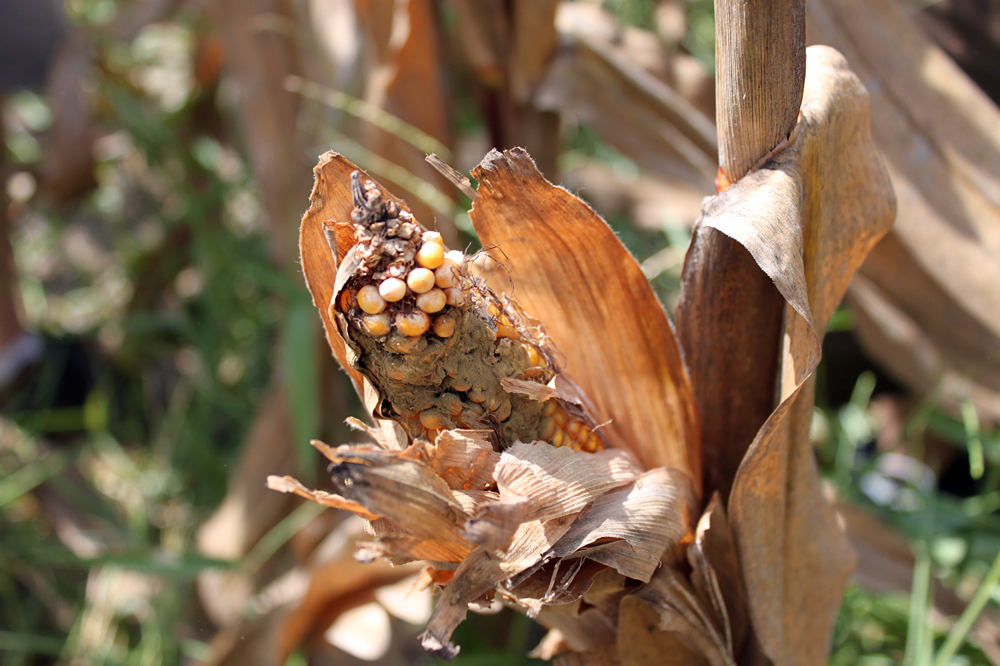
As many of you have already heard, 2012 heat and drought conditions in our local corn crop have led to the on-set of Aspergillus ear rot and associated aflatoxins concerns for the local livestock industry. Lab tests for the mold locally have detected low levels in most samples, with mold levels expected to rapidly increase with recent rain activity in the area. Local mills and grain buyers will also be utilizing UV or “black lights” at most facilities to quickly detect to possibility of the mold in delivered corn, with some loads possibly to be diverted or stored separately at their facilities.
Recommendations are for local corn producers to harvest the crop as soon as possible at higher moistures before the mold has a chance to become well established, and then dry down the grain well below 15% (recommended 12-13%, depending on source). Drying will reduce the opportunity for additional aflatoxins to be produced, although this will not reduce current levels.
For silage production, aflatoxins will usually remain at the levels found in the corn at time of ensilaging if the process is done correctly at the right moisture, in air-tight conditions, correctly compacted, etc.. Where corn is not correctly made into silage (too dry or too much air around chopped corn), the mold may continue to develop and raise aflatoxin levels as fermentation is slowed or fails.
Testing can be done through the Purdue Heeke ADDL lab at the Southern Indiana Purdue Ag. Center near Dubois, IN, or through numerous testing labs available through your local feed mills.
A recent AgAnswers news article addresses the topic in more detail and and additional information on the mold, testing and preventative measures can also be found in Purdue Extension Publication BP-83.
Wednesday, August 22, 2012
Stressed Plants May Look Like Early Fall

Early fall color and/or defoliation is common when plants are under stress and this season has been quite challenging for many trees, both old and young. The intense heat made it difficult for plants to keep up with water and cooling requirements, even in areas where moisture was adequate. Combine extreme heat with drought, and it is a wonder any plants survive. <Read More>
Monday, August 13, 2012
Upcoming Events - Livestock and Forage Drought Management Update
The drought of 2012 has presented some unique challenges to livestock producers with regards to forage supplies and pasture condition. Purdue Extension of Dubois, Perry, Spencer, and Warrick Counties is presenting a Livestock and Forage Drought Management Update to discuss these challenges and identify management tips for this year and beyond. Specific topics include Utilizing Alternative Feeds and Forages, Forage Nitrate and Nutrient Testing, Herd Management and Feeding Techniques, and Pasture Renovation. Featured speakers will include Dr. Keith Johnson, Purdue Extension Forage Specialist and Dr. Ron Lemenager, Purdue Extension Beef Specialist.
The update will be held August 16 at 6:30 PM CDT at the St. Meinrad Community Center. The update is free-of-charge but pre-registration is requested by August 13. For more information, or to register, please contact the Spencer County Purdue Extension Office at (812) 649-6022 or nheld@purdue.edu.
The update will be held August 16 at 6:30 PM CDT at the St. Meinrad Community Center. The update is free-of-charge but pre-registration is requested by August 13. For more information, or to register, please contact the Spencer County Purdue Extension Office at (812) 649-6022 or nheld@purdue.edu.
Tuesday, July 31, 2012
Weekly Outlook - Anticipating the Size of the 2012 Corn and Soybean Crops
The National Agricultural Statistics Service (NASS) of the
USDA will release the first yield and production forecasts for the 2012 U.S.
corn and soybean crops on August 10. The first forecasts of the season are
always highly anticipated, but none more than this year as widespread drought
conditions have resulted in a wide range of yield and production
expectations.
It might be useful to briefly review the NASS methodology for
making corn and soybean yield and production forecasts. Data for the forecasts
are collected in two separate surveys conducted roughly in the last week of July
and the first week of August for the August report. The Agricultural Yield
Survey (AYS) queries farm operators in 32 states for corn and 29 states for
soybeans asking operators to identify the number of acres to be harvested and to
forecast the final average yield. The sample of operators is based on a
sophisticated sample design to achieve the desired sample size and each state is
expected to achieve a minimum response rate of 80 percent. In 2011,
approximately 27,000 operators were surveyed for all crops for the August
report. Each operator is surveyed in subsequent months to obtain new forecasts
of acreage and yield. Historical relationships indicate that respondents tend to
be conservative in early forecasts of final yields (underestimate yield
potential), particularly in drought years. This tendency is quantified and
factored into official yield forecasts. <Read More>
Forage Crops Could Provide Opportunities Following Corn
A wide range of forage crops could help grain and livestock producers salvage some value from their fields once the drought-ravaged corn crop has been harvested - if soil moisture returns to a level that can support plant growth.
While damaged corn can be used as forage to feed livestock, it won't be enough to thwart forage shortages. Several forage crops are available for Indiana growers to plant in late summer or early fall, and that could serve as livestock feed in the spring.
"For the August seeding, an excellent consideration would be spring oat that will be harvested by machine, or a combination of spring oat and forage turnip if grazed by livestock," said Keith Johnson, Purdue Extension forage specialist. "Spring oat will not survive the winter.
"While the expectation is for turnips to winterkill, too, it has been observed that they can survive a mild Indiana winter."
Another possible choice is annual ryegrass, but growers who go this route need to pay close attention to keep the crop from becoming a nuisance. Johnson recommended an early seeding to have both fall and spring harvests. <Read More>
While damaged corn can be used as forage to feed livestock, it won't be enough to thwart forage shortages. Several forage crops are available for Indiana growers to plant in late summer or early fall, and that could serve as livestock feed in the spring.
"For the August seeding, an excellent consideration would be spring oat that will be harvested by machine, or a combination of spring oat and forage turnip if grazed by livestock," said Keith Johnson, Purdue Extension forage specialist. "Spring oat will not survive the winter.
"While the expectation is for turnips to winterkill, too, it has been observed that they can survive a mild Indiana winter."
Another possible choice is annual ryegrass, but growers who go this route need to pay close attention to keep the crop from becoming a nuisance. Johnson recommended an early seeding to have both fall and spring harvests. <Read More>
Heat and Drought Lead to Ear Rot Potential in Corn Grain, Silage
Heat and drought in the Corn Belt have created the perfect conditions for Aspergillus ear rot to develop in corn grain and silage - something Purdue Extension plant pathologists say grain and livestock producers need to prepare for.
The disease is caused by a fungus that produces aflatoxin, a toxic carcinogen for livestock that consume contaminated grain or silage.
Aspergillus ear rot normally shows up near the end of the corn growing season as the crop reaches the dent phase. Growers can identify the disease by peeling back the husks and looking for stunted ears with an olive-green dusty mold. <Read More>
The disease is caused by a fungus that produces aflatoxin, a toxic carcinogen for livestock that consume contaminated grain or silage.
Aspergillus ear rot normally shows up near the end of the corn growing season as the crop reaches the dent phase. Growers can identify the disease by peeling back the husks and looking for stunted ears with an olive-green dusty mold. <Read More>
Friday, July 27, 2012
Early Weaning as a Drought Strategy
In addition to utilizing alternative forages and feedstuffs, early weaning and other herd management techniques can be effective drought management strategies for livestock producers. The Purdue Animal Sciences Department recently created a video featuring Dr. Ron Lemenager discussing early weaning in times of drought and short forage supplies. The video is available here.
Vilsack Opens Emergency Haying and Grazing of CRP Acres for Entire State
Indiana Farm Service Agency (FSA) State Executive Director Julia A. Wickard today announced additional drought relief for Indiana’s livestock producers. USDA Secretary Tom Vilsack authorized the release of emergency haying and grazing for all Indiana counties for certain practices and acres enrolled in the Conservation Reserve Program (CRP) outside the primary nesting season for wildlife. This decision was based upon the U.S. Drought Monitor. <Read More>
Thursday, July 26, 2012
Weekly Outlook - Are Soybean Prices High Enough?
Much of the recent attention in commodity markets, at least
in the popular press, has focused on the U.S. corn crop and the potential impact
of drought conditions on production and prices. The focus has been warranted
since corn is the largest U.S. crop; corn is used in a wide variety of food,
feed, and industrial products; and corn yields are most susceptible to drought
conditions.
As the growing season progresses and adverse weather
conditions persist over large areas, more attention is being focused on the U.S.
soybean crop. The importance of the size of the U.S. crop is magnified by the
small South American harvest earlier this year. The USDA estimates that crop at
4.2 billion bushels, 16 percent smaller than the record crop of 2011. The USDA
expects South America to maintain a large export presence, however, by sharply
reducing inventories over the next year. Even so, the pace of exports of U.S.
soybeans remains stronger than normal for this time of year. The USDA now
projects 2011-12 marketing year exports at 1.34 billion bushels, 65 million more
than projected in March. With only six weeks left in the marketing year, exports
need to total 81 million bushels, 13.2 million per week, to reach the USDA
projection. Export inspections for the four weeks ended July 17 averaged 16.1
million. As of July 12, the USDA reported unshipped export sales for the current
year at 171.5 million bushels. It appears that exports may marginally exceed the
USDA projection. <Read More>
Subscribe to:
Posts (Atom)