Showing posts with label diseases. Show all posts

Monday, March 25, 2013

Winter Temperatures, Corn Flea Beetle Survival, and Potential for Stewart’s Wilt

  • Corn flea beetle winter survival is expected to be low in northern and central Indiana.
  • Moderate survival is expected for southern Indiana, higher in the Ohio River valley.
  • Corn flea beetle is a vector of Stewart’s bacterial wilt and leaf blight of corn.
  • Seed applied insecticides generally prevent early corn flea beetle feeding.
 
Corn flea beetle is a sporadic corn pest in Indiana and has had little impact of recent years. Still, winter temperatures in regions where beetles were abundant last season will determine if there is cause to be concerned this spring for susceptible inbreds and hybrids. This is especially important since this insect transmits the bacterium that causes Stewart’s disease in corn. The severity of the disease correlates with last season’s beetle abundance and this winter’s temperatures. This is because the Stewart’s wilt bacterium survives in the gut of the overwintering beetles and depends upon the beetle to infect corn. Warmer temperatures result in higher beetle survival, and therefore a greater potential for Stewart’s disease. <Read More> 
 

Thursday, December 20, 2012

Choosing Corn Hybrids for 2013

Hybrid selection is one of the most important management decisions a corn grower makes each year. It’s a decision that warrants a careful comparison of performance data. It should not be made in haste or based on limited data. Planting a marginal hybrid, or one not suitable for a particular production environment, imposes a ceiling on the yield potential of a field before it has been planted. In the Ohio Corn Performance Test (OCPT) (http://www.oardc.ohio-state.edu/corntrials/) it is not unusual for hybrid entries of similar maturity to differ in yield by 80 bu/A, or more, depending on test site.

Growers should choose hybrids best suited to their farm operation. Corn acreage, previous crop, soil type, tillage practices, desired harvest moisture, and pest problems determine the relative importance of such traits as drydown, insect and disease resistance, herbicide resistance, early plant vigor, etc. End uses of corn should also be considered - is corn to be used for grain or silage? Is it to be sold directly to the elevator as shelled grain or used on the farm? Are there premiums available at nearby elevators, or from end users, for identity-preserved (IP) specialty corns such as food grade or non-GMO corn? Capacity to harvest, dry and store grain also needs consideration. The following are some tips to consider in choosing hybrids that are best suited to various production systems.  <Read More>

Wednesday, October 3, 2012

Plant Pathologist: Wheat Planted in Corn Stubble at Risk for Head Scab

More corn acres brought on by high corn prices in recent years could tempt winter wheat growers to plant the crop into corn stubble, but a Purdue Extension pathologist says the practice puts wheat at risk for head scab development.

Head scab, or Fusariam head blight, is caused by the fungus Gibberella zeae, also known as Fusarium graminearum, which is harbored in corn residue. In corn, the fungus causes ear and stalk rots, and in wheat can lead to yield loss and reduced grain quality. The disease also produces a mycotoxin called deoxynivalenol, also called DON or vomitoxin, which is toxic to humans and livestock.  <Read More>

Tuesday, September 18, 2012

New Aspergillus Ear Rot Brochure

Aspergillus Ear Rot (Purdue University/Woloshuk)
Just over two weeks ago, I posted an article on Aspergillus Ear Rot in corn.  While this has not been a wide-spread problem in the area, conditions were ideal this summer for its development and there have been a few isolated reports of aspergillus presence in fields and resulting aflatoxin contamination in harvested grain.  A new quick-guide brochure has been developed by Purdue Extension and the Indiana Corn Marketing Council to provide producers with some tips on identification and management of aspergillus ear rot and aflatoxin.  The brochure is available here.   

Thursday, August 30, 2012

Aspergillus Ear Rot in Corn

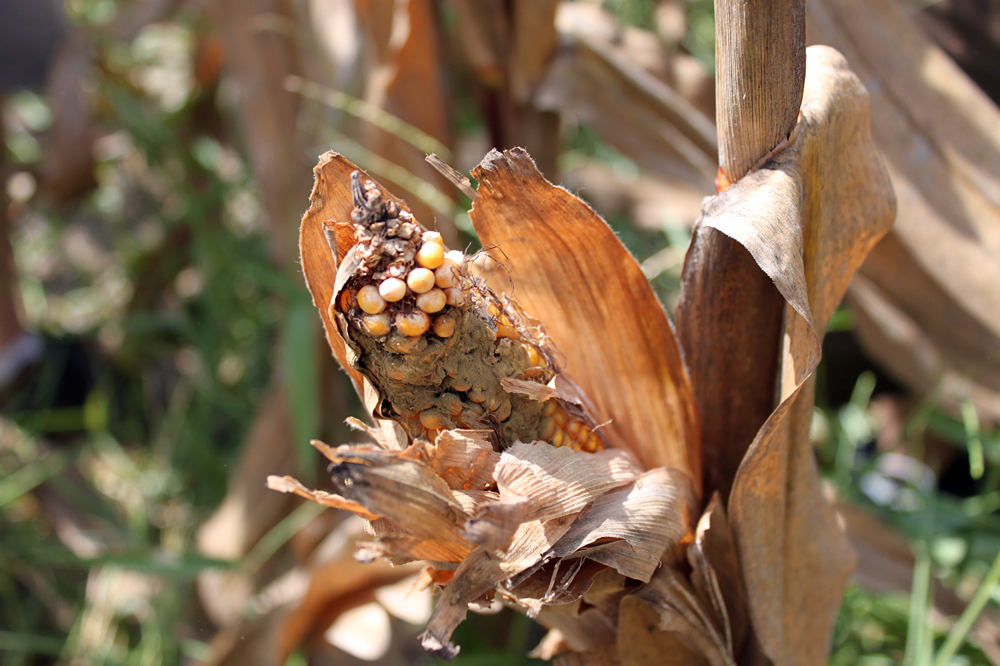
Powdery olive-green fungal spores are characteristic of
Aspergillus ear rot
Kenny Eck, Purdue Extension Educator, Dubois County

As many of you have already heard, 2012 heat and drought conditions in our local corn crop have led to the on-set of Aspergillus ear rot and associated aflatoxins concerns for the local livestock industry. Lab tests for the mold locally have detected low levels in most samples, with mold levels expected to rapidly increase with recent rain activity in the area. Local mills and grain buyers will also be utilizing UV or “black lights” at most facilities to quickly detect to possibility of the mold in delivered corn, with some loads possibly to be diverted or stored separately at their facilities.

Recommendations are for local corn producers to harvest the crop as soon as possible at higher moistures before the mold has a chance to become well established, and then dry down the grain well below 15% (recommended 12-13%, depending on source). Drying will reduce the opportunity for additional aflatoxins to be produced, although this will not reduce current levels.  

For silage production, aflatoxins will usually remain at the levels found in the corn at time of ensilaging if the process is done correctly at the right moisture, in air-tight conditions, correctly compacted, etc.. Where corn is not correctly made into silage (too dry or too much air around chopped corn), the mold may continue to develop and raise aflatoxin levels as fermentation is slowed or fails.

Testing can be done through the Purdue Heeke ADDL lab at the Southern Indiana Purdue Ag. Center near Dubois, IN, or through numerous testing labs available through your local feed mills.

A recent AgAnswers news article addresses the topic in more detail and and additional information on the mold, testing and preventative measures can also be found in Purdue Extension Publication BP-83

Thursday, August 23, 2012

Purdue Experts Remind About Proper Food Handling Amid Salmonellosis Outbreak

WEST LAFAYETTE, Ind. – Purdue University food safety experts are reminding consumers to thoroughly wash and properly store all produce in the wake of a salmonellosis outbreak in Kentucky.

The Kentucky Department for Public Health issued an alert Friday reporting that a salmonellosis outbreak in that state may be related to cantaloupes, specifically melons grown in southwestern Indiana. The alert said an investigation is continuing into other salmonellosis cases in Kentucky that could be related to cantaloupe and watermelon consumption. At this point, there has been no confirmation that any particular grower or growers are connected to the outbreak.
 
Haley Oliver, a Purdue food microbiologist, said the U.S. Food and Drug Administration advises washing cantaloupes under running water with a stiff brush and refrigerating the fruit within two hours of cutting.
 
"Proper refrigeration stops the growth of Salmonella and E. coli," Oliver said. "With cantaloupe, especially, you should entirely remove the rind from the fruit since that rind has crevices and is porous."
 
Oliver said all fruits and vegetables should be thoroughly washed, and anyone with compromised immune systems, including children or the elderly, should cook those foods.
 
"This doesn't mean that people need to stop eating melons. Proper washing of all produce minimizes risks of foodborne illnesses," Oliver said.
 
An FDA guide to selecting and safely serving fruits and vegetables can be viewed at: http://www.fda.gov/Food/ResourcesForYou/Consumers/ucm114299
 
Daniel Egel, a Purdue Extension plant pathologist who specializes in vegetable pathology, said that salmonella is often transferred to food through manure. He said that the U.S. Department of Agriculture requires that manure be applied long before crops are planted, that workers wash their hands and that produce should be thoroughly washed to prevent such incidents.

Tuesday, July 31, 2012

Heat and Drought Lead to Ear Rot Potential in Corn Grain, Silage

Heat and drought in the Corn Belt have created the perfect conditions for Aspergillus ear rot to develop in corn grain and silage - something Purdue Extension plant pathologists say grain and livestock producers need to prepare for.

The disease is caused by a fungus that produces aflatoxin, a toxic carcinogen for livestock that consume contaminated grain or silage. 

Aspergillus ear rot normally shows up near the end of the corn growing season as the crop reaches the dent phase. Growers can identify the disease by peeling back the husks and looking for stunted ears with an olive-green dusty mold.  <Read More>

Thursday, April 5, 2012

New and Improved Home Fruit Production Guide

A valuable Purdue Extension Fruit Production resource has recently been updated and improved. 

ID-146, Managing Pests in Home Fruit Plantings, contains information on variety selection and pest management for a variety of tree and small fruits, including apples, peaches, pears, plums, cherries, grapes, strawberries, blueberries, blackberries, gooseberries, currants and raspberries. Updates to the publication include revised chemical recommendations featuring new, safer products, organic pest management options, and the inclusion of currants and gooseberries.  

The publication is available online or at your local Purdue Extension Office.

Tuesday, March 13, 2012

Weird Weather and Pest Predictions

One of the most common questions that has come up in response to this season's winter weather (or lack thereof) is what effect it will have on pest problems this spring or summer, particularly insect populations.  Below are excerpts of responses given by two Extension experts. 

Larry Caplan, Extension Horticulture Educator in Vanderburgh County addressed this question in a recent newspaper column:
I was asked the other day what effect this strange weather will have on our pest problems this year. That is always a very tough topic for me. I don’t like to make predictions, because there are so many variables that can affect future events, rendering my predictions worthless. Still, there are a few things that I expect will happen this season.

First of all, everything will start happening at least 3 weeks earlier than normal because of the long warm-up we’ve had. Crabgrass germination occurs at about the same time as the forsythia shrub blooms. Usually, we can hold off applying our pre-emergent herbicides until mid to late March; this year, though, some parts of the tri-state may already be too late to get the best preventative control.

Dormant oil is applied to fruit trees to prevent later problems with spider mites. The oil needs to be applied before the trees bud out, otherwise the young leaves will be burned by the chemical. It’s already too late in some places. Likewise, the traditional orchard sprays to control disease and insect attacks should begin as the buds open. Normally, gardeners don’t expect to begin this until late March or early April, but I’ve already seen apple and cherry trees in bloom. Be sure to stop spraying while the flowers are open, so that you don’t hurt any bees that may be out.

The repeated storms of the last few weeks have dumped a lot of moisture on the tri-state. With moist conditions and standing water, we can expect increases in biting midges, mosquitoes, and crane flies. This is what we’ve seen for the last couple of years, which have all been pretty wet.

Warm, moist weather is ideal for fire blight, a bacterial disease that attacks apples, crabapples, and pears. The bacteria usually enters the tree through the flowers, but it can also enter twigs damaged by hail storms. Spraying the antibiotic Streptomycin during bloom and after a hail storm may offer some protection.

If warm weather continues, we may see an earlier emergence of Japanese beetles, eastern tent caterpillars, and other pests, but I don’t believe we’ll see increased numbers. Very few of these insects are killed by severe winters, so I don’t think their survival rate will change much.
And from Dr. Rick Foster, Purdue Extension Entomology Specialist, some points focusing specifically on insect populations:
While some insects, such as flea beetles, are directly impacted by cold winter weather and experience greater survival and higher populations as a result of mild winters such as the one we just experienced, many insect species are very well adapted to winter weather and will survive just fine no matter how cold it is.

Most insects have an amazing ability to reproduce in large numbers and, if spring and summer weather is conducive, will be able to develop to serious population levels no matter how many survived the winter.

Finally, some of our pests overwinter indoors and others overwinter in the South, so our winter weather has little effect on their populations.

The bottom line is that for a few insects, we can definitely expect higher populations, but for many others, we just can’t predict.
As you can see, there is no one answer to this seemingly simple question.  While winter weather conditions have little effect on most insect populations, it is the earlier-than-normal emergence of these insects, as well as weeds and diseases, that will be the most likely effect of our mild winter.  And, as Mr. Caplan adds, this is Indiana, so it could snow this weekend and change everything!